
Every U.S. local business should claim key citation sources such as Google Business Profile, Apple Business Connect, Bing Places, Facebook Business Pages, Yelp, Yellow Pages (YP), Better Business Bureau (BBB), Foursquare, TripAdvisor, and Data Axle (formerly Infogroup). These ten dominate because they feed Google's local index, drive direct consumer traffic, and power the data aggregator networks that push your business information to hundreds of downstream directories. As Mailchimp explains, search engines use NAP consistency across these sources to verify your business's location and legitimacy.
Your single next step: search your business name plus your city on Google right now. If your Google Business Profile is unclaimed, claim it before touching anything else. Everything else builds on that foundation.
The ten must-haves, at a glance:
- Google Business Profile — the anchor of every local SEO strategy; controls your Maps listing and Knowledge Panel
- Apple Business Connect — reaches every iPhone user searching in Apple Maps
- Bing Places — indexes into Microsoft's search and powers Cortana results
- Facebook Business Pages — high consumer trust, strong social indexing
- Yelp — dominant in restaurants, home services, and health; feeds Apple Maps data
- Yellow Pages / YP — legacy authority with strong aggregator connections
- Better Business Bureau — trust signal, especially for service businesses
- Foursquare — a major data aggregator that feeds dozens of apps and directories
- TripAdvisor — critical for hospitality, restaurants, and tourism-adjacent businesses
- Data Axle / Infogroup — one of the three primary U.S. data aggregators; a single correct record here cascades to hundreds of sites
Table of Contents
- The best general local citation sites, ranked by priority
- Which niche directories actually move the needle for your industry
- How to find city- and county-level directories worth your time
- How to claim, verify, and optimize a listing step by step
- NAP consistency, duplicate handling, and how to maintain citations over time
- Tools and services for managing citations: when to DIY and when to hire
- Realistic timelines and costs for building and maintaining citations
- How citations connect to your website and Google Business Profile
- What you can do this week and this quarter to get started
- Key Takeaways
- Citations work best when your site is built to support them
- Forge-web-studio builds the local foundation your citations point to
- Useful sources and further reading
The best general local citation sites, ranked by priority
Not every directory deserves equal time. WordStream recommends prioritizing the 10–20 highest-authority sources rather than chasing volume, and that advice holds up in practice. Work through the tiers below in order.
Tier 1: Must-have (claim these first)
| Platform | Priority | Ease of Claiming | Cost | Verification Method | Time to Publish | Aggregator Impact |
|---|---|---|---|---|---|---|
| Google Business Profile | Must-have | Moderate | Free (paid ads optional) | Postcard, phone, or video | 1–7 days | High — feeds Maps, Search |
| Apple Business Connect | Must-have | Easy | Free | Email confirmation | 1–3 days | High — feeds all Apple Maps |
| Bing Places | Must-have | Easy | Free | Phone or postcard | 1–5 days | Moderate |
| Facebook Business Pages | Must-have | Easy | Free (paid ads optional) | Email or phone | Immediate | Moderate |
| Yelp | Must-have | Easy | Free (paid ads optional) | Phone | 1–3 days | High — feeds Apple Maps |
| Data Axle / Infogroup | Must-have | Moderate | Free basic / paid enhanced | 2–6 weeks | Very high — cascades to 300+ sites | |
| Foursquare for Business | Must-have | Easy | Free | 1–2 weeks | Very high — feeds apps and directories | |
| Neustar Localeze | Must-have | Moderate | Paid subscription | 2–4 weeks | Very high — major aggregator |
Tier 2: Important (claim within your first month)
| Platform | Priority | Ease of Claiming | Cost | Verification Method | Time to Publish | Aggregator Impact |
|---|---|---|---|---|---|---|
| Yellow Pages / YP | Important | Easy | Free basic | Phone or email | 3–7 days | Moderate |
| Better Business Bureau | Important | Moderate | Free basic / paid accreditation | Manual review | 1–4 weeks | Low direct, high trust signal |
| TripAdvisor | Important | Easy | Free | 1–5 days | Moderate — hospitality focus | |
| Manta | Important | Easy | Free | 3–7 days | Low | |
| Hotfrog | Important | Easy | Free | 3–7 days | Low | |
| Superpages | Important | Easy | Free | Phone | 3–7 days | Moderate |
| MapQuest | Important | Easy | Free | 1–2 weeks | Low |
Tier 3: Optional (add after the first 20)
Angi (formerly Angie's List), Thumbtack, Alignable, MerchantCircle, Brownbook, Cylex, and Judy's Book round out a solid general citation profile. BrightLocal's Top 50 general citation list is the most practical reference for working through this tier systematically.
On data aggregators: Data Axle, Neustar Localeze, and Foursquare operate differently from standard directories. Submit one accurate record to each, and they distribute your NAP to hundreds of downstream sites automatically. WordStream notes that a single aggregator submission can cascade to many directories at once, which is why getting your aggregator records right matters more than manually claiming every small directory. Fix errors at the aggregator level first; the downstream sites will eventually correct themselves.
Quick tips by platform:
- BBB: — The free listing is worth claiming for the trust signal alone. Paid accreditation is optional and most valuable for service businesses where consumer trust is a purchase barrier.
Which niche directories actually move the needle for your industry
General directories build your baseline. Niche directories deliver two things general sites cannot: direct leads from buyers already in purchase mode, and a relevance signal that tells Google your business belongs in a specific category. A roofing company listed on HomeAdvisor sends a clearer vertical signal than a listing on a generic directory, even if the generic site has more traffic.

The distinction matters when you're deciding where to spend paid listing budget. A high-authority niche site in your vertical is usually worth more than five mid-tier general directories.
Home services and contractors:
- Angi (formerly Angie's List) and HomeAdvisor — both generate direct leads and carry strong domain authority
- Houzz — particularly strong for remodelers, interior designers, and architects
- Porch — growing platform for home improvement pros
- BuildZoom — contractor-specific with license verification, which adds credibility
- Thumbtack — lead-gen focused; worth a free profile even if you don't pay for leads
For contractors specifically, Forge-web-studio's contractor SEO guidance covers how niche directory presence pairs with site architecture to drive local leads.
Healthcare and medical:
- Healthgrades, Zocdoc, Vitals, and WebMD's provider directory
- Psychology Today (for mental health providers)
- RateMDs and US News Health for physicians
Legal:
- Avvo, FindLaw, Justia, and Martindale-Hubbell
- State bar association directories (these carry particular authority because they're primary sources)
Restaurants and hospitality:
- TripAdvisor and OpenTable (reservation integration makes OpenTable especially valuable)
- Zomato, Grubhub, DoorDash, and Uber Eats business pages
- For event venues, a listing on The Knot or WeddingWire adds a high-intent audience
Lodging:
- Booking.com, Expedia, and Hotels.com business listings
- Google Hotel Ads (managed through your Google Business Profile)
B2B and professional services:
- LinkedIn Company Pages — the strongest B2B citation by far
- Clutch.co for agencies and tech firms
- Dun & Bradstreet (D&B) — important for businesses that work with enterprise clients who run credit checks
- Kompass and ThomasNet for manufacturing and industrial
Pro Tip: Before paying for a niche directory listing, run the site's domain through a free authority checker. Look for a domain rating above 40 and check whether the site's business profile pages are actually indexed in Google. A directory that doesn't get indexed contributes nothing to your local SEO, regardless of how much traffic the site claims.
To scout new niche directories, use Google search operators: site:directory.com "your city" "your trade" shows whether a directory actively indexes local businesses in your category. You can also run a competitor's website through a backlink tool to see which directories link to them but not to you.
How to find city- and county-level directories worth your time
City-specific directories are where most businesses stop looking, and that's exactly why they're worth pursuing. A listing in your local chamber of commerce directory or a regional business journal carries geographic authority that no national platform can replicate.
Search operators that surface real local directories:
"[city name]" "business directory" -site:yelp.com -site:yellowpages.com"[city name] chamber of commerce" member directory"[county name]" "local businesses" directory"[city name]" site:.gov OR site:.org "business listing""[neighborhood name]" "local business" directory
Run these in Google and look at the first two pages of results. Genuine local directories will have editorial content, a real contact page, and business listings that include actual NAP data, not just scraped snippets.
What makes a local directory worth claiming:
- The site has a real editorial team or organization behind it (chamber, newspaper, municipal government)
- Business profile pages are individually indexed (test by searching
site:directory.com "business name") - The domain has been active for more than two years
- The listing page includes a physical address or contact form for the directory itself
- You can find the directory linked from other legitimate local sites (city government pages, local news)
Chamber of commerce listings deserve special attention. Most U.S. chambers offer free member directories, and some offer paid enhanced listings. The SEO value is real: chamber sites typically have strong local domain authority and are trusted by Google as legitimate local institutions. The verification process usually involves proof of membership, which takes a week or two but is straightforward.
Municipal and tourism listings are often overlooked. Many city governments maintain "local business" pages or tourism portals. Search [city] official visitor guide businesses or check your city's .gov domain directly.

Pro Tip: Watch out for "local directory" sites that are actually scrape farms. Red flags: no contact information for the directory itself, hundreds of thin business pages with identical formatting, no original editorial content, and a domain registered in the last six months. These sites often rank temporarily but get deindexed, taking your listing with them.
How to claim, verify, and optimize a listing step by step
Before you touch a single directory, prepare your canonical NAP block. This is the exact version of your business name, address, and phone number that you will copy-paste identically onto every platform. Inconsistencies here are what cause data drift.
Step 1: Prepare your canonical business metadata
Write down and save these fields in a document you'll reference every time:
- Legal business name (exactly as it appears on your Google Business Profile — no added keywords)
- Street address (use the USPS standardized format; check at usps.com/zip4)
- Phone number (use one consistent format: (512) 555-0100 or 512-555-0100, not both)
- Website URL (use the same URL every time — with or without "www," consistently)
- Primary business category
- 2–3 supporting categories
- Business description (150–300 words, written once, varied slightly per platform)
- Hours of operation
- 5–10 high-quality photos
Step 2: Claim or create the profile
Search the platform for your business before creating a new listing. Unclaimed listings often already exist, populated with data pulled from aggregators. Claiming an existing listing is always better than creating a duplicate.
Step 3: Verify
Verification methods vary by platform:
- Google Business Profile: Phone call, postcard (5–14 days), or video verification
- Bing Places: Phone or postcard (3–10 days)
- Yelp: Phone call (immediate) or email
- Apple Business Connect: Email (1–3 days)
- BBB: Manual review by BBB staff (1–4 weeks)
- Data Axle / aggregators: Email confirmation, then 2–6 weeks for data to propagate
Step 4: Complete every field
Partial profiles underperform. Fill in every available field: name, address, phone, website, categories, hours, description, photos, and any platform-specific fields (menu for restaurants, services list for contractors, accepted insurance for healthcare providers).
Step 5: Confirm the listing is indexed
Submission is not the same as indexing. WordStream advises checking whether your listing page is actually indexed before counting it as an SEO asset. To check: copy the URL of your listing page and search site:directory.com/your-listing-url in Google. If it returns a result, you're indexed. If not, wait two weeks and check again. A listing that isn't indexed contributes no SEO value regardless of how complete it is.
Fields checklist for maximum value:
- Exact business name (no keyword additions)
- Full street address in USPS format
- Local phone number (not a tracking number that changes)
- Website URL (consistent across all platforms)
- Primary category (most important ranking signal on most platforms)
- 2–3 secondary categories
- Business description with natural mention of your city and services
- Hours (including holiday hours when applicable)
- At least 5 photos (exterior, interior, team, products/services)
NAP consistency, duplicate handling, and how to maintain citations over time
BrightLocal notes that many business owners assume a listing is permanent once submitted. It isn't. Directories get updated by third parties, aggregators push conflicting data, and user-suggested edits can alter your listing without notice. Citation building is ongoing maintenance, not a one-time task.
The NAP consistency rules
Your business name on every directory must match your Google Business Profile exactly. No exceptions. Mailchimp warns that adding keywords to your business name on directories — "Smith Plumbing Best Plumber Austin" instead of "Smith Plumbing" — can trigger algorithmic red flags and damage your local ranking signals. Use your legal business name, every time.
Address format matters too. "Suite 200" and "Ste 200" and "#200" are technically the same, but search engines may treat them as different addresses. Pick one format and use it everywhere.
Finding and fixing duplicates
Duplicates happen when a business moves, rebrands, or gets listed by aggregators before claiming their profile. To find them:
- Search your business name in quotes on Google, Yelp, and Facebook
- Use a citation audit tool (BrightLocal, Moz Local, or Whitespark all surface duplicates)
- Check aggregator portals directly (Data Axle, Neustar Localeze, Foursquare)
When you find a duplicate, the priority order is: claim it, then request a merge or removal through the platform's support process. Never just abandon a duplicate — it will continue to push conflicting data.
Structured vs. unstructured citations
A structured citation is a formal business listing on a directory with defined NAP fields. An unstructured citation is a mention of your business on a blog post, news article, or community page — no formal listing, but your name, address, or phone appears in the text. Both count. Unstructured citations from local news sites and community blogs can carry significant authority, especially in competitive local markets.
Audit cadence and tracking template
Pro Tip: Run a citation audit quarterly. Set a recurring calendar reminder for the first week of each quarter. A quarterly cadence catches data drift before it compounds.
| Field | What to Check | Last Checked |
|---|---|---|
| Business name | Matches GBP exactly, no keyword additions | [date] |
| Street address | USPS format, consistent across all platforms | [date] |
| Phone number | Same format everywhere, no tracking number swaps | [date] |
| Website URL | Correct URL, no redirects or broken links | [date] |
| Primary category | Still accurate for current services | [date] |
| Hours | Current, including seasonal changes | [date] |
| Photos | At least 5, recent, no outdated branding | [date] |
| Duplicates | None found on major platforms | [date] |
Tools and services for managing citations: when to DIY and when to hire
The right approach depends on how many locations you have, how much time you can spend, and how competitive your local market is.
Tool categories and what they do:
- Citation finders: Whitespark's Citation Finder and BrightLocal's Citation Tracker show where you're listed and where competitors are listed that you aren't. Both are paid tools with trial options.
- Listing managers: Moz Local and Yext push your NAP to multiple directories from a single dashboard and monitor for changes. Yext's network is broader but more expensive; Moz Local is more affordable for single-location businesses.
- Aggregator submission services: Submitting directly to Data Axle, Neustar Localeze, and Foursquare manually is free but slow. Some tools (including BrightLocal) offer aggregator submission as a paid add-on that speeds up the process.
- Monitoring tools: BrightLocal's Reputation Manager and similar tools alert you when a listing changes, a new duplicate appears, or a review goes unanswered.
Decision guide:
| Situation | Best Approach |
|---|---|
| Single location, tight budget | Manual claiming on Tier 1 sites + free BrightLocal audit |
| Single location, some budget | Moz Local or BrightLocal subscription ($15–$40/month range) |
| 2–5 locations | BrightLocal or Whitespark managed plan |
| 5+ locations or franchise | Yext or agency-managed service |
| No time, any size | Managed citation service through an agency |
How to evaluate any citation tool before buying:
- Does it check whether your listings are actually indexed, not just submitted?
- Does it detect and flag duplicates automatically?
- Which aggregators does it submit to directly (Data Axle, Neustar Localeze, Foursquare)?
- Does it offer API-level updates or just manual form submissions?
- What does the reporting look like — can you see listing status by platform?
BrightLocal's free USA business directory list is a practical starting point for businesses that want to work manually before committing to a paid tool.
Realistic timelines and costs for building and maintaining citations
Most businesses underestimate how long citation work takes and overestimate how quickly it affects rankings. Here's what to actually expect.
Time estimates by method:
- Manual claiming on a single Tier 1 platform: 20–45 minutes per site (including verification wait)
- Completing all 10 must-have sites manually: 4–8 hours of active work, spread over 2–4 weeks (due to verification delays)
- Aggregator submission (manual): 1–2 hours per aggregator; data propagation takes 2–6 weeks
- Tier 2 and Tier 3 sites: 10–20 minutes per site once you have your canonical NAP ready
Cost shape by approach:
- Manual / DIY: Free in dollars, expensive in time. Realistic for a single-location business with an owner or staff member who can dedicate a few hours per week.
- SaaS tools: Moz Local and similar tools run in the $15–$40/month range for single-location plans. Yext's plans are higher, typically $199+/year for a basic network.
- Managed agency services: Citation-building packages from local SEO agencies typically run $300–$600 for an initial build, with monthly maintenance options.
Timeline table:
| Phase | Tasks | Expected Outcome |
|---|---|---|
| Week 1 | Claim and verify Google Business Profile, Apple Business Connect, Bing Places, Facebook | Core local presence established; Maps listings active |
| Month 1 | Complete all 10 must-haves; submit to Data Axle, Neustar Localeze, Foursquare | Aggregator data in pipeline; Tier 1 citations live |
| Quarter 1 | Add Tier 2 and niche directories; run first citation audit; fix any duplicates found | 20–30 citations live; data drift caught early |
| Ongoing | Quarterly audit; update hours/photos seasonally; respond to reviews | Stable citation profile; no conflicting NAP data |
Single vs. multi-location: A single-location business can complete the core citation build manually in about a month. Multi-location businesses should use a tool or agency from the start — the time cost of manual claiming multiplies linearly with each location, and the risk of NAP inconsistencies across locations is much higher.
How citations connect to your website and Google Business Profile
Citations don't work in isolation. Uberall explains that citations are one of several local ranking signals, and they perform best when combined with a well-optimized Google Business Profile and localized site content. Here's how to connect the two.
Canonical contact block on your website
Every page of your site should include your NAP in the footer, formatted exactly as it appears on your Google Business Profile. This is not just for users — it's a consistency signal for crawlers. Use plain HTML text, not an image, so it's readable by search engines.
Schema markup (structured data)
Add LocalBusiness schema to your homepage and contact page. This tells Google your business name, address, phone, hours, and service area in a machine-readable format. For most small business sites, the JSON-LD format is the simplest to implement. Tools like Google's Rich Results Test let you validate the markup before publishing.
City and service pages
If you serve multiple cities or neighborhoods, build individual pages for each location. Each page should include the local NAP, a Google Maps embed, and content specific to that area. This architecture amplifies your citation signals because your site's location data matches what's in your directory listings. For Texas businesses, Forge-web-studio's city pages guide covers this architecture in detail.
Connecting citations to GBP Insights
After your Tier 1 citations are live, watch your Google Business Profile Insights for changes in "how customers find you" — specifically the split between direct searches (people searching your name) and discovery searches (people searching your category). A growing discovery search share is one of the clearest signals that your citation and local SEO work is gaining traction.
Pro Tip: After any major citation update — a new address, phone number, or business name change — update your Google Business Profile first, then work through your directory list in Tier order. GBP is the source of truth that other platforms often pull from. Getting it right first reduces the chance of conflicting data propagating from your own profile.
Common integration pitfalls:
- Using a tracking phone number on directories that differs from your GBP number (creates NAP inconsistency)
- Embedding your address as an image in your site footer (crawlers can't read it)
- Forgetting to update citations after a move or phone number change
- Building city pages with identical content except for the city name (thin content; won't rank)
For a full site-level audit that covers these signals, Forge-web-studio's website review checklist walks through the contact, schema, and local SEO elements that support citation work.
What you can do this week and this quarter to get started
The gap between knowing what to do and actually doing it is where most local SEO efforts stall. Here's a concrete plan.
This week (one to three hours):
- Search your business name plus city on Google. Note every listing that appears — claimed and unclaimed.
- Claim your Google Business Profile if it isn't already claimed. Complete every field.
- Check your Apple Business Connect and Bing Places listings. Claim or correct them.
- Write your canonical NAP block and save it somewhere you can copy-paste from every time.
- Claim your Facebook Business Page and Yelp listing if unclaimed.
This quarter:
- Complete all 10 must-have citations (the full shortlist from the opening of this article).
- Submit your NAP to Data Axle, Neustar Localeze, and Foursquare directly.
- Identify 5–10 niche directories relevant to your industry and claim them.
- Search for your city's chamber of commerce directory and any municipal business listings.
- Run a citation audit using BrightLocal's free tool or a manual Google search for duplicates.
- Set a quarterly calendar reminder for your next audit.
If you only have one hour this week:
Spend it entirely on Google Business Profile. Complete every field, add photos, and verify the listing. A fully optimized GBP outperforms ten incomplete directory listings. Everything else is secondary to getting that one right.
If your budget is tight this quarter:
Start with BrightLocal's free USA directory list and work through the free Tier 1 and Tier 2 sites manually. The aggregator submissions (Data Axle, Neustar Localeze) are free at the basic level and deliver the highest return per hour of effort.
Key Takeaways
Strong local citation work starts with ten must-have platforms, requires exact NAP consistency across every listing, and demands a quarterly audit cadence to prevent data drift from eroding the rankings you've built.
| Point | Details |
|---|---|
| Start with the 10 must-haves | Google Business Profile, Apple Business Connect, Bing Places, Facebook, Yelp, YP, BBB, Foursquare, TripAdvisor, and Data Axle cover the highest-priority citation sources. |
| NAP must be exact everywhere | Your business name, address, and phone must match your Google Business Profile character-for-character on every directory. |
| Audit quarterly, not once | Listings degrade and develop duplicates over time; a quarterly check catches data drift before it compounds into ranking damage. |
| Aggregators multiply your reach | Submitting accurate data to Data Axle, Neustar Localeze, and Foursquare cascades your NAP to hundreds of downstream directories automatically. |
| Forge-web-studio integrates citations into site builds | For Texas businesses, Forge-web-studio handles GBP setup, schema markup, and local SEO as part of its website projects, so citation work connects directly to site architecture from day one. |
Citations work best when your site is built to support them
Most local businesses treat citation building as a standalone task, separate from their website. That's a mistake. After years of building local sites for Texas businesses, the pattern is consistent: a business with 50 citations and a poorly structured website will lose to a competitor with 20 citations and a site that Google can actually read and trust.
The businesses that see the fastest local ranking improvements are the ones where the citation NAP matches the site footer, the schema markup is in place, the GBP is fully built out, and the contact page is clear and crawlable. Citations are a signal, and your website is what that signal points to. If the destination is weak, the signal loses value.
There's also a timing issue most guides ignore. Claiming citations before your website is live, or before your GBP is complete, means you're sending traffic and trust signals to an incomplete destination. The right order is: build or fix the site first, complete the GBP, then build citations outward from that foundation. Doing it in reverse wastes the authority you're accumulating.
The other thing worth saying plainly: quality beats quantity every time. A business with a clean, consistent presence on 20 authoritative platforms will outrank one with 200 inconsistent listings on low-quality directories. Chase the right sites, not the highest count.
Forge-web-studio builds the local foundation your citations point to
Citations drive traffic to your website and your Google Business Profile. If either of those destinations isn't built to convert, you're paying for visibility that doesn't turn into calls or customers.
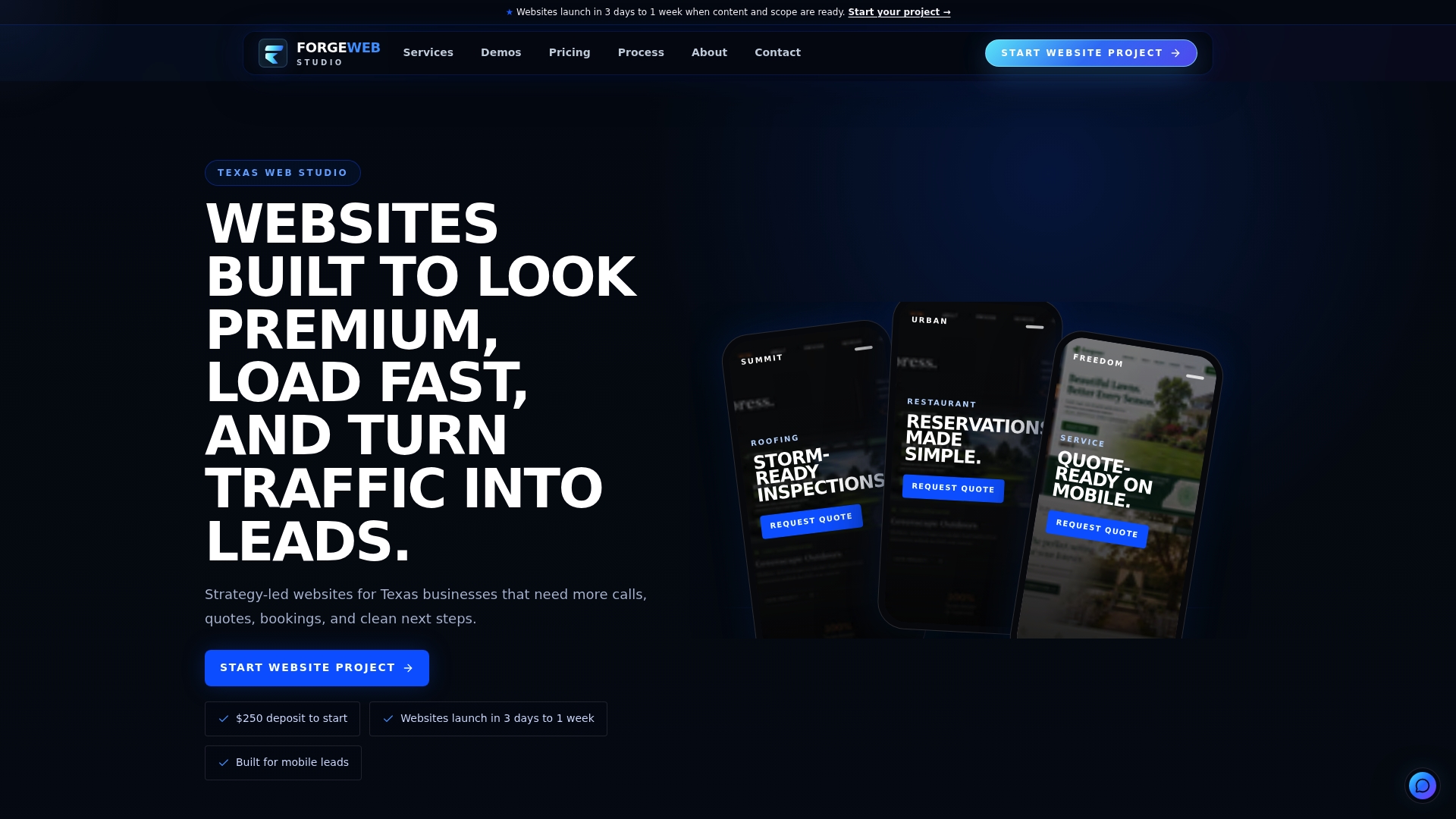
Forge-web-studio builds strategy-led websites for Texas businesses that are designed from the ground up for local search. That means a canonical contact block in the footer, LocalBusiness schema on every relevant page, city and service page architecture that matches your citation footprint, and a Google Business Profile setup that's integrated with the site from launch. Projects go live in 3 days to a week, and local SEO setup is part of the build, not an afterthought.
If you're ready to make your citation work actually count, start with a site that's built to support it. See Forge-web-studio's local SEO services or browse the full web design services to find the right fit for your business.
Useful sources and further reading
These are the primary sources used to compile this article. Each is worth bookmarking for ongoing reference.
- What are Local Search Citations? | Mailchimp — Clear explanation of NAP consistency and why keyword-stuffed business names damage local rankings. Good foundational reading.
- What is local citation building? | BrightLocal — BrightLocal's guide to citation building as an ongoing process, including why audits matter and how duplicates form.
- How to build local citations & boost your visibility | WordStream — Practical guide covering aggregator strategy, indexing verification, and the quality-over-quantity principle.
- Top 50 General Citation Sites | BrightLocal — The most widely used reference list for building out a general citation profile beyond the core 10–20.
- Top Free USA Business Directories | BrightLocal — Free-only directory list for businesses starting without a paid tool budget.
- What Is Local SEO Citation | Uberall — Covers how citations interact with GBP, reviews, and localized content as a combined local ranking system.
- What Is a Local Citation? | Moz — Moz's authoritative definition of structured and unstructured citations and their role in local search rankings.