
The fastest way for a roofing company to increase local leads is to own the Google map pack and match city-by-city search intent. Everything else, including paid ads, social media, and blog content, amplifies what the map pack already does. If your Google Business Profile is incomplete and your site has no service-by-city pages, you're invisible to the homeowners who are ready to call right now.
Here's where to start this week:
- Claim and fully complete your Google Business Profile (primary category: Roofing Contractor).
- Build or audit your top three service-by-city pages with localized proof.
- Send review requests to your last 10 completed jobs.
- Add LocalBusiness/RoofingContractor schema to your homepage and service pages.
- Set up call tracking so you know which leads come from search.
30/60/90-day timeline:
- Days 1–30: Lock down GBP, fix NAP consistency across directories, publish your first two service-by-city pages, and activate call tracking.
- Days 31–60: Build five more location pages, launch a review-request workflow, fix Core Web Vitals on mobile, and publish one seasonal content piece.
- Days 61–90: Add FAQ schema, pursue two local links (supplier directory, local news), and review your first month of verified call data.
Track these KPIs from day one: verified inbound calls, Google Business Profile impressions, map-pack position for your top three keywords, and cost per verified lead. Raw form fills are not leads until someone confirms them.
Key Takeaways
Roofing local SEO produces the fastest lead gains when GBP optimization, service-by-city pages, and verified call tracking are built and running together from the first 30 days.
| Point | Details |
|---|---|
| Own the map pack first | GBP signals drive roughly one-third of map-pack ranking factors; complete your profile before anything else. |
| Build service-by-city pages | Each service-and-city combination needs its own page with local proof, photos, and a direct CTA. |
| Publish storm content early | Storm-related search volume can spike 300–400%; content must be live at least 60 days before peak season. |
| Measure verified leads, not raw calls | Track cost per verified lead using call recording to get an accurate picture of SEO ROI. |
| Forge-web-studio for fast execution | Forge-web-studio builds mobile-first roofing sites with city-page architecture and GBP integration in three days to a week. |
Table of Contents
- Why roofing local SEO should be your top marketing priority
- How to set up your Google Business Profile to dominate the map pack
- How to structure your roofing website for local search
- Technical SEO your roofing site needs to rank and convert
- Reviews, citations, and links that actually move local rankings
- Content strategy and seasonal pages that capture storm-season leads
- How to measure results, set a realistic timeline, and budget for SEO
- Website and lead-flow checklist for roofing companies
- Your 30/60/90-day execution plan
- How to optimize for voice search in local roofing queries
- How to use social media to generate local roofing leads
- How paid local ads complement your roofing SEO strategy
- How to compete in saturated local roofing markets
- What most roofing SEO advice gets wrong
- Forge-web-studio builds roofing sites that rank and convert
- Sources
Why roofing local SEO should be your top marketing priority
Roofing is one of the most geographically concentrated service categories in search. When a homeowner types "roof repair near me" or "storm damage roofing [city]," they are not browsing. They are ready to call. Local search behavior data shows a large share of local searches result in a phone call or visit within 24 hours, which makes map-pack visibility a direct revenue lever, not a vanity metric.
The revenue stakes are high. A single roof replacement can run from several thousand to tens of thousands of dollars, according to Angi's cost data.
Three use cases drive the majority of roofing search volume:
- Emergency storm response: Homeowners search within hours of a hail or wind event. These are the highest-urgency, highest-value calls.
- Insurance claim work: Searches like "roof insurance claim help [city]" signal a homeowner who already knows they need a contractor and wants a guide through the process.
- Planned replacement: Lower urgency but high job value. These searchers compare reviews and credentials before calling.
Storm-related roofing queries can spike 300–400% immediately after a weather event in affected markets. The roofers who capture those calls are the ones whose GBP and storm-content pages were already live and ranking before the storm hit. Waiting until the hail falls is too late.
How to set up your Google Business Profile to dominate the map pack
GBP signals drive roughly one-third of map-pack ranking factors, making it the single highest-leverage asset in roofing local SEO. Most roofers have a profile but leave half the fields blank. That's a free ranking advantage you're handing to competitors.
Step-by-step GBP setup for roofers
- Set your primary category to "Roofing Contractor." Secondary categories like "General Contractor" or "Gutter Cleaning Service" can be added, but the primary drives the most weight.
- Fill in every service. List each service individually: roof replacement, roof repair, storm damage inspection, gutter installation, emergency tarping. Add a short description and price range where possible.
- Define your service area accurately. List the specific cities and zip codes you actually serve. Overbroad service areas dilute relevance.
- Set accurate hours and add holiday hours. Profiles with complete hours get more clicks.
- Add attributes. "Free estimates," "Veteran-owned," "Licensed and insured" all appear in your profile and influence trust.
- Upload photos weekly. Completed job photos with location data embedded in the file are the most effective. Aim for at least 10 photos before launch, then add two to three per week.
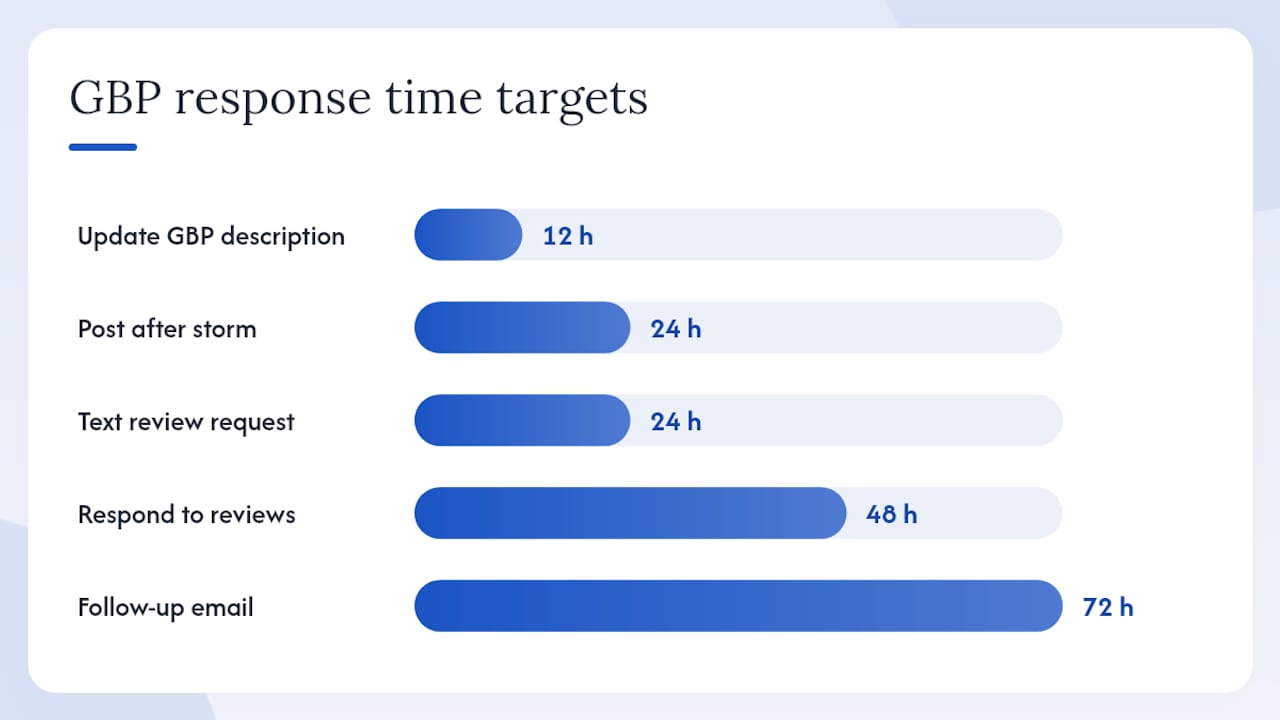
- Publish GBP posts. One post per week minimum. After a storm, post within 24 hours: "We're inspecting storm damage in [Neighborhood], [City]. Call now for a free assessment."
- Manage Q&A proactively. Seed your own questions ("Do you offer free estimates?") and answer them. This content appears in your profile and influences local relevance.
Pro Tip: After a major storm, update your GBP description and post a storm-response offer within the first 12 hours. Profiles with recent activity rank higher during high-demand windows, and homeowners searching at 9 PM after a hail event will see your post before they see a competitor's stale profile.
Reviews are the other half of the GBP equation. Industry data shows more than 80% of homeowners read reviews before choosing a contractor, and recent reviews influence both ranking and conversion. Your review-generation workflow should be:
- Send a text message request within 24 hours of job completion.
- Include a direct link to your GBP review page (no extra clicks).
- Follow up once by email if no review after 72 hours.
- Respond to every review, positive or negative, within 48 hours.
Keywords in review text matter. When a customer writes "best roof replacement in Katy, TX," that phrase reinforces your local relevance for that query. You can't write their review, but you can ask specific questions: "Would you mention the city and what we worked on?" Most customers are happy to help.
How to structure your roofing website for local search
Site architecture is where most roofing websites fail. A single "Services" page with a paragraph about each offering does nothing for local rankings. Google needs a dedicated page for each service-by-city combination to understand what you do and where you do it.
The recommended structure looks like this:
- Homepage: Brand, primary service area, trust signals, click-to-call CTA.
- Service hub pages: One page per major service (roof replacement, roof repair, storm damage, gutters).
- Service-by-city pages: "Roof Replacement in Houston," "Storm Damage Repair in Katy," "Roof Repair in Sugar Land." These are your ranking workhorses.
- Blog and FAQ: Seasonal content, insurance guides, and how-to articles that capture informational queries and build topical authority.
Choosing which city pages to build first
Start with the cities where you've already done jobs and can include real project photos, neighborhood names, and local proof. A page that says "We replaced a roof on Oak Ridge Drive in The Woodlands after the April hail storm" outperforms a generic template every time.
For each service-by-city page, include:
- The primary keyword in the H1, URL, and meta title (e.g., "Roof Replacement in Katy, TX").
- A project photo from that city with a descriptive alt tag.
- A mention of local neighborhoods, landmarks, or zip codes.
- A customer review from that city, if available.
- A clear CTA: phone number, estimate form, or both.
- FAQ section addressing local concerns (permit requirements, common storm types in that area).
Keyword targeting by intent type
Different searches need different pages. Map your content to intent:
- Storm/emergency: "emergency roof repair [city]," "storm damage roofer [city]," "hail damage roof [city]"
- Insurance: "roof insurance claim [city]," "insurance approved roofer [city]"
- Replacement: "roof replacement cost [city]," "new roof installation [city]"
- Inspection: "free roof inspection [city]," "roof inspection after storm [city]"
Each of these intent clusters deserves its own page, not a paragraph buried in a general services page. A well-built roofing website treats each service-city combination as a standalone landing page with its own proof, CTA, and schema.
Technical SEO your roofing site needs to rank and convert
Technical issues are silent lead killers. A roofing site that loads slowly on mobile or lacks schema markup loses calls it never knew it could have had.
Mobile speed and Core Web Vitals
Most roofing searches happen on mobile, often right after a storm. Your site needs to load fast and make calling easy. Priorities:
- Largest Contentful Paint (LCP) under 2.5 seconds. Compress hero images, use next-gen formats (WebP), and defer non-critical scripts.
- Click-to-call button above the fold. On mobile, the phone number should be tappable without scrolling.
- Lazy-load your project gallery. Photo-heavy roofing sites are the most common cause of slow mobile load times.
- Minimize Cumulative Layout Shift (CLS). Reserve space for images so the page doesn't jump as it loads.
Schema markup for roofers
Schema tells Google exactly what your business is and what each page covers. Implement these:
- LocalBusiness / RoofingContractor schema on your homepage: name, address, phone, service area, hours, and aggregate rating.
- Service schema on each service page.
- Review schema to display star ratings in search results.
- FAQ schema on pages with Q&A sections.
Use Google's Rich Results Test to verify your markup is valid before publishing.
Crawlability checklist
- Submit an XML sitemap to Google Search Console.
- Set canonical tags on location pages to prevent duplicate content issues.
- Block staging or duplicate URLs in robots.txt.
- Check for crawl errors in Google Search Console monthly.
- Use Screaming Frog or Sitebulb to audit internal links and find orphaned pages.
Reviews, citations, and links that actually move local rankings
Getting and managing reviews
The timing of a review request matters more than most roofers realize. The best moment is within 24 hours of the final walkthrough, when the homeowner is still relieved and satisfied. A text message with a direct link converts far better than an email with instructions.
For citation management:
- Audit your existing listings using BrightLocal or Whitespark. Look for inconsistent NAP (name, address, phone) across directories.
- Correct the top-priority directories first: Google, Yelp, BBB, Angi, HomeAdvisor, and Houzz.
- Add your business to roofing-specific directories: GAF's contractor finder, CertainTeed's contractor locator, and NRCA's member directory.
- Maintain consistent NAP across every listing. Even a suite number formatted differently can dilute citation authority.
Local link building for roofers
Links from local sources carry more weight than generic directory links. Realistic opportunities:
- Manufacturer contractor directories: GAF Master Elite and CertainTeed SELECT ShingleMaster listings include a link to your site.
- Local news coverage: After a major storm, pitch your local newspaper or TV station as a source for storm-damage advice. One quote earns a link.
- Sponsorships: Little league teams, local charity events, and community organizations often list sponsors on their websites.
- Supplier partnerships: Ask your roofing supply distributor if they have a contractor referral page.
- Chamber of Commerce: A paid membership typically includes a directory listing with a dofollow link.
Review text reinforces local relevance in ways that pure link building cannot. When customers mention your city, the service type, and specific details about the job, those keywords appear in your GBP and on third-party review platforms, creating a consistent signal that you serve that area and do that work.
Content strategy and seasonal pages that capture storm-season leads
The roofers who rank during storm season published their storm content well before peak weather windows. Seasonal content must be live before the season to rank when demand spikes, because Google needs time to crawl, index, and evaluate new pages.
High-conversion content ideas
- "What to do after a hail storm: [City] homeowner's guide"
- "How to file a roof insurance claim in Texas (step-by-step)"
- "Emergency roof tarping in [City]: 24-hour service"
- "Hail damage vs. normal wear: how to tell the difference"
- "How long does a roof replacement take in [City]?"
- "Best roofing materials for [City]'s climate"
One-page content template for service-by-city and seasonal pages
Every page should include, in order:
- H1 with primary keyword and city name.
- Opening paragraph that answers the searcher's core question in two sentences.
- Local proof: a project photo, a named neighborhood, or a customer review from that city.
- Service details: what's included, timeline, and what to expect.
- FAQ section (3–5 questions) with FAQ schema.
- CTA: phone number, estimate form, and a trust signal (license number, years in business, manufacturer certification).
Seasonal content calendar
- January–February: Publish or refresh winter storm and ice dam content. Build authority during the slow season.
- March–April: Publish spring hail and storm-prep content. This is the pre-season window.
- May–August: Storm-response posts go live within hours of weather events. Publish insurance claim guides.
- September–October: Post-summer inspection content and "before winter" replacement guides.
- November–December: Off-season discounts, year-end inspection offers, and case study roundups.
Repurpose project photos by turning them into before/after posts on your GBP, embedding them in city pages, and using them as social proof in estimate follow-up emails. A single job photo can appear in five different places and reinforce your local presence each time.
How to measure results, set a realistic timeline, and budget for SEO
KPIs that matter for roofing SEO
Track these, in order of importance:
- Verified inbound calls: Calls confirmed as real leads, not spam or wrong numbers. Use CallRail or a similar call-tracking platform to record and review calls.
- GBP impressions and actions: How many people saw your profile and clicked to call, get directions, or visit your site.
- Map-pack position: Track your ranking for your top 3–5 keywords in each target city using BrightLocal or Local Falcon.
- Organic call volume: Calls attributed to organic search, separate from GBP direct calls.
- Cost per verified lead: Total SEO spend divided by verified leads. This is the number that tells you whether the investment is working.
Roofing-specific KPI frameworks recommend tracking verified-call rate and cost-per-verified-lead rather than raw form fills, because unverified leads inflate perceived performance and make it impossible to calculate true ROI.
Realistic timeline
A focused roofing SEO campaign typically shows early movement within about 90 days, with dominant local rankings commonly achieved in 6–12 months. Here's what to expect at each stage:
- Month 1–3: GBP improvements show first. You may see increased profile views and a small uptick in calls. New city pages begin indexing.
- Month 3–6: City pages start ranking for lower-competition queries. Review count grows. Organic call volume increases noticeably.
- Month 6–12: Map-pack positions stabilize for primary keywords. Seasonal content captures storm-window traffic. Cost per verified lead drops as volume grows.
Ballpark SEO pricing for roofers
Pricing varies by market size and scope, but common ranges in the U.S. market:
- One-off GBP optimization and citation cleanup: $500–$1,500.
- Website project with service-by-city architecture: $2,500–$8,000 depending on page count and complexity.
- Monthly local SEO retainer (ongoing GBP management, content, links): $750–$2,500 per month for a single-market roofer; more for multi-city campaigns.
Local paid ads are often layered on top of SEO during storm windows to capture immediate demand while organic rankings build. Google Local Services Ads (LSAs) are particularly effective for roofers because they show above the map pack and charge per verified lead rather than per click.
Website and lead-flow checklist for roofing companies
A well-ranked page that fails to convert is just expensive traffic. Run through this audit before you start driving more visitors to your site.
Site and GBP audit checklist
- Mobile load time under 3 seconds (test with Google PageSpeed Insights).
- Click-to-call button visible without scrolling on every mobile page.
- Phone number in the header on desktop and mobile.
- Service-by-city pages exist for your top 5 markets.
- Each city page has a local photo, a local review, and a localized CTA.
- LocalBusiness schema is valid (test with Google's Rich Results Test).
- GBP is fully complete: all services listed, photos updated in the last 30 days, no unanswered reviews.
- NAP is consistent across your website, GBP, and top 10 directory listings.
- Estimate form works on mobile and sends a confirmation email.
- Call tracking is active and calls are being reviewed weekly.
For a deeper look at what a high-converting roofing site should include, the roofing website examples from Forge-web-studio show mobile-first layouts and lead-flow patterns that work in competitive Texas markets.
CRO elements worth testing
- CTA copy: "Get a Free Estimate" vs. "Call Now for a Free Roof Inspection" — the second version specifies the offer and tends to convert better for emergency intent.
- Click-to-call placement: Test the button in the header, mid-page after the service description, and at the bottom of the page. Most roofing sites see the highest tap rate on the header button.
- Trust signals near the CTA: License number, manufacturer certification badge, and "X years in business" placed directly above or below the estimate form reduce form abandonment.
Sites that fix mobile speed and add a visible click-to-call button typically see measurable increases in call volume within the first 30 days, before any ranking changes take effect. Conversion rate improvements from UX fixes are often faster than ranking gains. Use the website review checklist to audit your current setup against these standards.
Your 30/60/90-day execution plan
Days 1–30: Foundation (business owner or agency)
- Complete GBP: all fields, services, photos, and first post.
- Audit NAP consistency across Google, Yelp, BBB, and Angi.
- Install call tracking (CallRail or similar).
- Publish two service-by-city pages for your highest-revenue markets.
- Send review requests to your last 10 completed jobs.
Owner vs. agency split: GBP completion and review requests are tasks the owner or office manager can handle. NAP audits and page builds are faster and more accurate when handled by an agency or a web team with local SEO experience.
Days 31–60: Build (primarily agency or marketing lead)
- Build five more service-by-city pages.
- Publish one seasonal content piece (storm guide or insurance walkthrough).
- Fix Core Web Vitals issues identified in PageSpeed Insights.
- Add LocalBusiness and Service schema to all key pages.
- Submit sitemap to Google Search Console.
Days 61–90: Amplify (shared)
- Pursue two local links (manufacturer directory, local news pitch, or chamber listing).
- Add FAQ schema to your top three pages.
- Review first 90 days of call data: which pages drive calls, which don't.
- Adjust city page priority based on actual call data.
When to build pages yourself vs. buying a website project: If your current site is on WordPress or a similar CMS and you can add pages without breaking the layout, build city pages yourself using the template above. If your site is slow, not mobile-friendly, or built on a platform that makes adding pages difficult, a full website project is the faster path. A new site built with the right architecture from day one avoids months of retrofitting.
How to optimize for voice search in local roofing queries
Voice search queries are longer and more conversational than typed searches. Instead of "roof repair Houston," a voice searcher says "Who fixes roofs near me in Houston?" or "What's the best roofing company in Katy Texas?" Optimizing for these queries is mostly an extension of what you're already doing for local SEO, with a few specific adjustments.
FAQ sections on your service pages are the most direct path to voice search visibility. Google often pulls voice answers from FAQ schema markup. Write your FAQ questions the way a homeowner would actually ask them: "How much does a roof replacement cost in Houston?" rather than "Roof replacement cost Houston."
Your GBP description and Q&A section also feed voice results. Keep your GBP description conversational and include natural phrases like "We serve homeowners in [City] and surrounding areas" rather than keyword-stuffed strings.
Page speed matters even more for voice. Voice results typically come from pages that load fast and have clear, structured answers near the top of the page. If your site takes five seconds to load on mobile, it won't be the source of a voice answer.
How to use social media to generate local roofing leads
Social media doesn't replace local SEO for roofers, but it reinforces it. The platforms that produce the most direct leads for roofing companies are Facebook and Nextdoor, both of which have strong neighborhood-level targeting.
Facebook works best for before/after project photos, storm-response announcements, and targeted ads to homeowners in specific zip codes. A post showing a completed hail damage repair in a recognizable neighborhood gets shared by neighbors and generates inbound messages. Facebook's ad platform lets you target homeowners by zip code, age, and homeownership status, which is a precise match for roofing's customer profile.
Nextdoor is underused by roofers. Homeowners actively ask for contractor recommendations on Nextdoor, and a verified business profile with positive recommendations from neighbors converts at a high rate. Claim your Nextdoor Business Page, respond to recommendation requests, and post storm-response updates after weather events.
Instagram is useful for brand building and photo content but generates fewer direct leads than Facebook or Nextdoor for most roofers. Use it to post project photos and team content, and link your Instagram to your Facebook page so posts publish to both simultaneously.
The key discipline across all platforms: post within hours of a storm event in your service area. A Facebook post that says "We're taking storm damage calls in [Neighborhood] right now, call [number]" posted at 7 PM after a hail storm will generate calls the same night.
How paid local ads complement your roofing SEO strategy
Paid ads and SEO serve different timelines. SEO builds durable rankings over months. Paid ads generate calls tomorrow. For roofers, the most effective approach uses both: SEO as the foundation, paid ads as the storm-season accelerant.
Google Local Services Ads (LSAs) are the highest-priority paid channel for roofers. They appear above the map pack, carry a "Google Screened" or "Google Guaranteed" badge, and charge per verified lead rather than per click. For a roofer, that means you pay only when someone calls and the call meets Google's criteria for a real lead. Home services search advertising benchmarks show that paid local ads are commonly used alongside SEO to capture immediate demand during storm windows.
To qualify for LSAs, you need a verified GBP, a background check, and proof of licensing and insurance. The setup takes one to two weeks, so complete it before storm season, not during.
Google Search Ads (standard PPC) are useful for capturing high-intent queries that your organic rankings haven't reached yet, particularly in new service cities or for services you've recently added. Target exact-match keywords like "emergency roof repair [city]" and send traffic to a dedicated landing page, not your homepage.
Facebook Ads work well for retargeting homeowners who visited your site but didn't call, and for proactive storm-response campaigns targeted by zip code. A $300–$500 Facebook ad spend during a storm window, targeting homeowners within 15 miles of the affected area, can generate a strong return when the creative is a before/after photo with a clear call to action.
The practical rule: run LSAs year-round at a modest budget, increase spend aggressively during storm windows, and let organic SEO handle the baseline volume.
How to compete in saturated local roofing markets
In competitive markets like Houston, Dallas, or Atlanta, the top three map-pack spots are held by roofers who have more reviews, more citations, and more location pages than everyone else. Closing that gap requires a clear differentiation strategy, not just more of the same tactics.
Start with a competitive gap analysis. Search your top three keywords in your target city and note what the top-ranked roofers have: review count, review recency, number of GBP photos, number of city pages on their site, and any certifications or badges displayed. Tools like BrightLocal, Semrush, or Ahrefs can show you their backlink profile and keyword rankings. The gaps you find are your roadmap.
Differentiation signals that move rankings and conversions:
- A higher review count with more recent reviews than competitors.
- Manufacturer certifications (GAF Master Elite, CertainTeed SELECT) that competitors don't hold.
- More specific city pages: if competitors have a "Houston" page, you build pages for Katy, Sugar Land, The Woodlands, and Pearland separately.
- Faster response time signals: GBP posts within hours of a storm, same-day estimate offers in your profile.
- Stronger E-E-A-T: named owner or lead estimator on the About page, license number displayed, years in business, and real project photos with location data.
In a saturated market, the roofer who wins is rarely the one with the best website design. It's the one with the most consistent local signals across GBP, citations, reviews, and location pages. Pick the two or three signals where you're furthest behind the top competitor and close those gaps first.
Niche targeting is another path in competitive markets. Instead of competing for "roof replacement Houston" against 50 established roofers, dominate "metal roof installation Katy TX" or "flat roof repair commercial Houston" where competition is thinner and job values are comparable.
What most roofing SEO advice gets wrong
Most roofing SEO guides treat the map pack and the organic results as separate problems. They're not. The same signals that improve your GBP ranking, which are reviews, NAP consistency, and local content, also strengthen your organic pages. The roofers who pull ahead fastest are the ones who work both simultaneously rather than finishing GBP optimization before touching the website.
The other thing guides consistently understate: verified lead measurement changes everything. Most roofing companies track form fills and call volume and call it good. But a significant share of those calls are spam, wrong numbers, or existing customers. When you filter down to verified new leads, the cost per acquisition often looks very different from what the raw numbers suggest. That's not a reason to distrust SEO. It's a reason to measure it correctly from the start, so you know what's actually working.
Speed-first website builds matter more for roofers than for almost any other service category. A homeowner calling at 8 PM after a storm is on a phone with a cracked screen, bad signal, and zero patience. If your site takes four seconds to load and the phone number isn't immediately visible, they're calling the next result. That's a $10,000 job lost to a slow hero image.
Forge-web-studio builds roofing sites that rank and convert
Roofing companies in Texas need more than a good-looking website. They need a site that loads fast on mobile, routes every visitor to a call or estimate form, and is built with the service-by-city architecture that local SEO requires from day one.
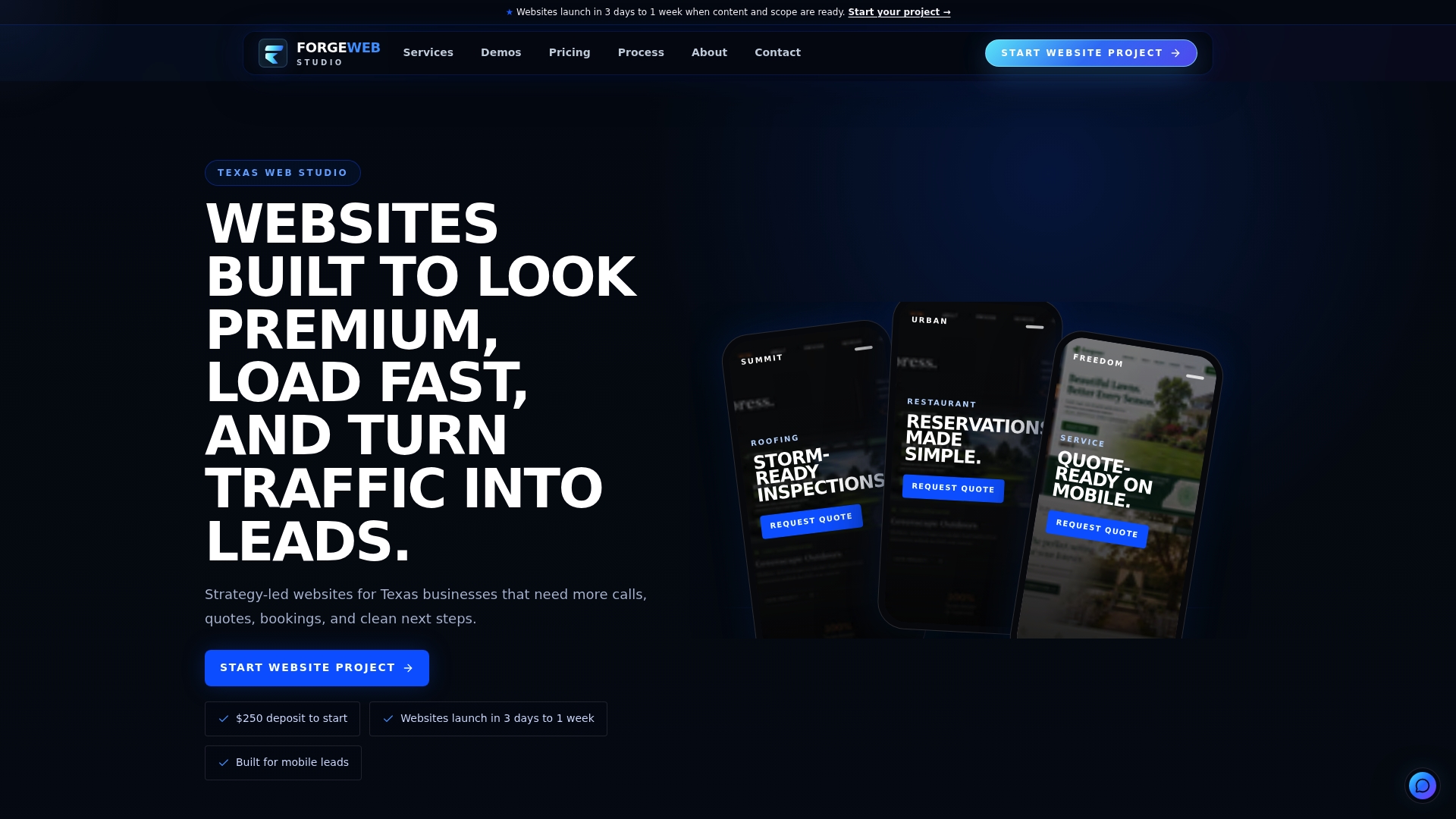
Forge-web-studio delivers roofing websites in three days to a week, built mobile-first with click-to-call layouts, service-by-city page structure, and Google Business Profile integration already in place. No months-long agency retainer before you see a page. The local SEO services include GBP optimization, citation cleanup, and ongoing content, so the site keeps earning calls after launch. For roofers who need a site that works as hard as they do, request a free site review and see exactly what's costing you leads right now.