
An effective About page needs five things: a clear statement of who you serve and what you do, proof visitors can verify, real people with real faces, a scannable structure under a thousand words, and exactly one call to action. Skip any of these and visitors leave without the confidence to contact you. The checklist below breaks down each piece, in the order it should appear on the page.
TL;DR:
- An About page must start with a clear positioning statement that directly states who you serve and what problem you solve.
- Including two to three verifiable proof points, like testimonials, press mentions, or certifications, enhances credibility without overwhelming the visitor.
- Use real photos of your team or founder, avoid staged stock images, and keep video under 90 seconds to build trust quickly.
- Place one prominent call to action and contact details above the fold to encourage immediate engagement.
- Regularly update proof points and team photos every six months to ensure the page remains accurate and continues to convert visitors.
Table of Contents
- What Should an About Page Include? The Essential Checklist
- How Should You Structure and Order Your About Page Content?
- Which Visuals Actually Build Trust on an About Page?
- What Proof and Trust Signals Should You Show?
- How Do You Write a Founder Story That Doesn't Lose Readers?
- Three Copy-Ready About Page Templates
- A Rapid-Launch Checklist for Fixing an About Page Fast
- Why Your About Page Needs a Biannual Checkup
- Get Your About Page Built Right the First Time
- Sources
- FAQ
What Should an About Page Include? The Essential Checklist
An About page succeeds or fails on a handful of decisions, not a hundred small ones. WordStream's research found About pages rank among the most visited pages on a small business site, which means the content on it carries real weight in whether someone calls you or clicks away. Here is what belongs on it, why each piece matters, and how to write it.
- Positioning statement. Name who you serve and the problem you solve in the first sentence. A roofing company in Waco should say "we replace storm-damaged roofs for Central Texas homeowners," not "we've been in business since 2009."
- Mission tied to outcomes. Skip abstract values like "integrity" and "excellence." Say what those values produce for the customer instead, like faster callbacks or fewer surprise charges.
- Benefits over self-praise. Visitors don't care that you're "passionate" about your craft. They care whether you'll show up on time and fix the problem right the first time.
- Human proof. Names, roles, and real photos of the people who'll actually answer the phone or show up at the job site.
- Rational proof. Numbers, testimonials, press mentions, or certifications that a skeptical visitor could go verify.
- Scannable design. Short paragraphs, a clear navigation label ("About" or "Our Story," not "Learn More"), and enough white space that the page doesn't feel like a wall of text.
- One CTA and visible contact details. A phone number, a contact form link, or a booking button that appears without scrolling.
Squarespace's guidance lines up with this order: mission first, then story, then team and proof, then the ask. That sequence isn't arbitrary. It mirrors how a stranger actually evaluates whether to trust you, moving from "what do you do" to "can I believe you" to "what happens if I click this button."
How Should You Structure and Order Your About Page Content?
Content order affects conversion more than most business owners realize. Lead with the wrong section and visitors bounce before they hit your proof.
- Open with positioning. The first 100 words should answer "who are you and why does this matter to me" without making the visitor scroll or guess.
- Follow with proof. Numbers, testimonials, or certifications come next, while the visitor is still deciding whether to trust the mission statement they just read.
- Introduce your people. Names, roles, and photos humanize the business after the visitor already has a reason to care.
- Tell the story, briefly. This is where founder background and company history go, not before.
- Close with one CTA. Repeat it partway down the page for longer layouts, but never introduce a second competing action.
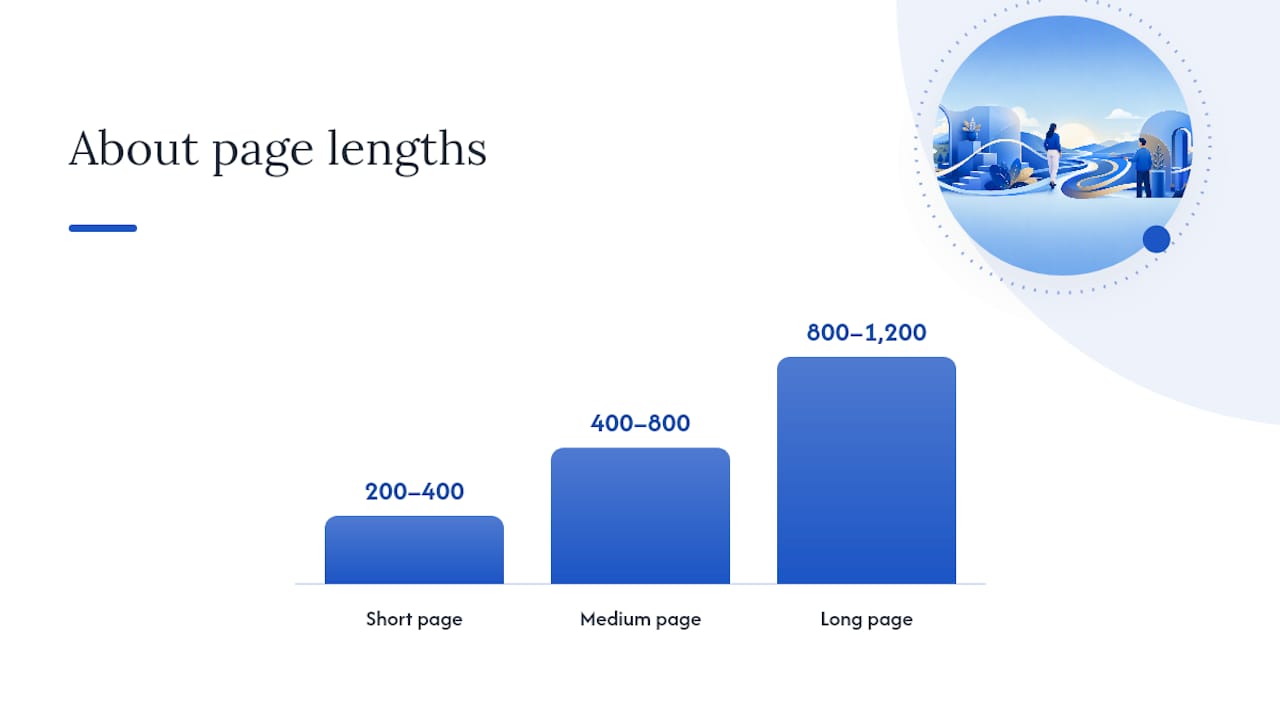
Length depends on your business. A short page (200 to 400 words) works for solo operators and simple service businesses where the positioning and one testimonial say everything needed. A medium page (400 to 800 words) fits most local businesses with a small team and a few proof points to showcase. A long page (800 to 1,200 words) makes sense for businesses with a complex story, multiple locations, or several certifications worth explaining.
Most small businesses do better with a single scrollable page than a multi-tab About section. Splitting content across "Our Story," "Our Team," and "Our Values" as separate pages adds clicks without adding trust, and MailerLite's page guidance backs concise, consolidated pages over fragmented ones.
Which Visuals Actually Build Trust on an About Page?
Photos and video carry more trust weight than copy on an About page, and the wrong choice here undoes good writing fast.
- Skip staged stock photos. A photo of your actual team, even shot on a phone in decent light, reads as more credible than a polished stock image of strangers in a boardroom.
- Keep video under 90 seconds. A short founder introduction or a quick walk-through of your shop outperforms a long production, according to photography and video guidance from Studio2U.
- Compress images properly. Aim for file sizes under 200KB where possible so the page loads fast on mobile, and write descriptive alt text for every photo (not just "team photo," but "Maria Gonzalez, lead electrician, on a residential job in Austin").
- Use client logos sparingly. Three to five recognizable logos say more than ten unfamiliar ones crammed into a row.
Pro Tip: If you can only afford one professional photo, make it a genuine shot of the owner or lead technician looking approachable, not a formal headshot in a suit against a gray backdrop. It reads as more trustworthy for local service businesses.
What Proof and Trust Signals Should You Show?
Specific, checkable details do more for credibility than adjectives ever will. "We've completed over 400 roof replacements in the Austin metro" beats "we're experienced" every time, because a visitor can mentally test the first claim against reality and the second one just sits there unverified.
- Use real numbers tied to a specific outcome, like years in business, jobs completed, or repeat customer rate.
- Show two to three testimonials with full attribution. A first name and last initial plus a city carries more weight than "Anonymous Client."
- Display certifications, licenses, and press mentions where you have them, and link to the original source when possible so visitors can verify.
- Update proof regularly. A testimonial from 2019 sitting alone on the page raises more questions than it answers.
Conversion problems on About pages rarely come from missing content. They come from burying two or three good proof points under paragraphs of filler, or from stacking so many competing calls to action that visitors freeze instead of clicking. Two or three focused proofs and a single CTA outperform a page trying to prove everything at once.
How Do You Write a Founder Story That Doesn't Lose Readers?
The founder story exists to answer one question: why should this person trust you specifically? It does not exist to recount your entire career.
- Open with the visitor's problem, not your origin story. "Homeowners kept calling us after other contractors left jobs half finished" pulls a reader in faster than "I started this company in my garage in 2015."
- Keep your biography short and relevant. Mention the license, the trade certification, or the years of hands-on experience that directly back your service claim. Cut the unrelated career history.
- Use first person for solo operators and small teams. "I founded this company because..." reads as more authentic than a third-person bio when there are only two or three people on staff.
- Skip long timelines. Nobody needs a decade-by-decade account. One sentence on why you started, one on what changed, and you're done.
Three Copy-Ready About Page Templates
Pick the frame that matches your brand personality, then fill in the blanks.
- Mission-first template: "We help [audience] [solve specific problem] through [your method]. Since [year], we've [specific proof point]. [Team member names] handle every job personally, because [reason this matters to the customer]. Ready to [desired action]? [CTA]."
- Benefits-first template: "Struggling with [common problem]? [Business name] fixes that by [specific benefit]. Our clients see [measurable outcome], backed by [certification or credential]. Meet the team behind it: [names and roles]. [CTA]."
- Story-centered template: "[Founder name] started [business] after [specific problem or frustration]. Today, [business name] has [proof point], serving [audience] across [service area]. [Brief team introduction]. [CTA]."
A compact example for a local business, using the benefits-first template: "Pipes acting up at 2 AM? Austin Flow Plumbing answers calls around the clock, with licensed plumbers on-site within two hours across the metro. Since 2016, we've completed over 3,000 repairs with a 98 percent same-visit fix rate. Owner Marcus Reyes and his team of four handle every job personally. Need help today? Call or book online below."
Swap the industry-specific language and the template holds for a bakery, a landscaping crew, or a solo consultant. A consultant-focused site usually leans harder on the founder's credentials, while a product-based business shifts more weight toward proof and less toward personal story.
A Rapid-Launch Checklist for Fixing an About Page Fast
Most About pages Forge Web Studio audits fail on the same handful of items, and fixing them takes an afternoon, not a rebuild.
- Confirm you have at least one real team photo, not a stock image.
- Include two to three proof points: a number, a testimonial, or a certification.
- Place a single CTA above the fold and repeat it at the bottom.
- List a phone number or contact link that's visible without scrolling on mobile.
- Check page load speed on a phone, since a slow About page loses visitors before they read a word.
Pro Tip: Swap in a real headshot and move your strongest proof point above the fold. Those two changes alone tend to move engagement more than a full rewrite.
Why Your About Page Needs a Biannual Checkup
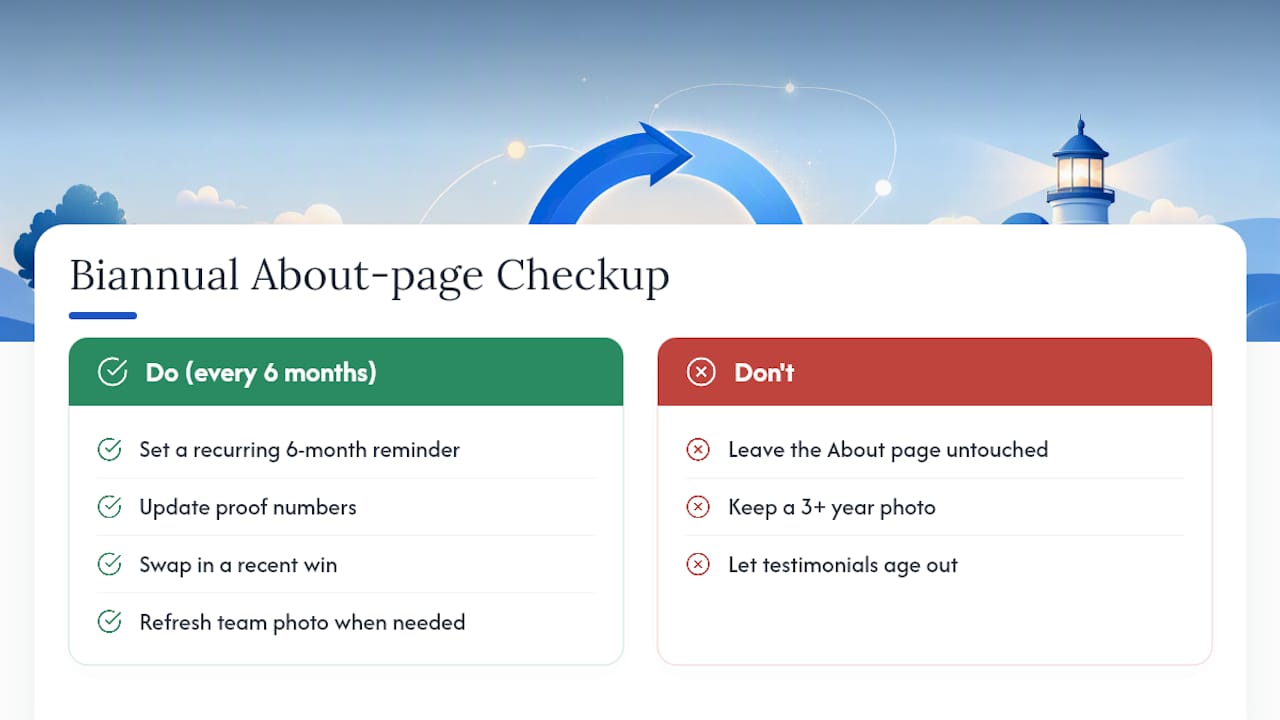
Most small business owners write the About page once and never touch it again. That's the mistake. Numbers go stale, testimonials age out, and a photo from three years ago starts working against you once your team changes.
Set a recurring reminder every six months to update proof numbers and swap in a recent win. One habit, applied consistently, keeps the page doing its job: convincing a stranger you're worth calling today, not five years ago.
— Dylan
Get Your About Page Built Right the First Time
Forge-web-studio builds About pages that put positioning, proof, and a single CTA above the fold, not buried under decorative copy that never gets read. Unlike a slow agency rebuild that drags on for months, a focused About-page refresh through our responsive website development process typically launches in days, with mobile clarity and lead flow built in from the first draft.
That means a mobile-optimized layout, a working contact path, and trust signals placed where visitors actually look, without you having to guess at structure or hire a copywriter separately. If your current About page reads like a company history report instead of a reason to call, check our website review checklist to see exactly what's missing, then reach out to get a rapid rebuild scoped for your business.
Sources
For deeper templates and examples beyond this guide, WordStream's About Us template and Jasper's About page guide both offer additional copy frameworks. Developers adding structured data should reference the AboutPage schema and the related founder schema type for marking up team and organization facts.
- How to Write a Great About Us Page (+Template) | WordStream
- How to Write an About Us Page (Template and Examples) — Squarespace
- Web pages a website should have — MailerLite
FAQ
What should an About page include?
At minimum, a clear statement of who you serve, proof like testimonials or certifications, real photos of your team, and one visible call to action with contact details.
What are the 7 C's of a website?
Definitions vary across sources, but the concept generally points to clarity, content, consistency, credibility, contact, calls to action, and compatibility across devices, all of which an About page should reflect.
What are five important things a website needs?
A clear value proposition, fast mobile load times, visible contact information, trust signals like reviews or certifications, and an obvious next step for the visitor to take.
What are the golden rules for a good website?
Keep it fast, mobile-friendly, easy to navigate, honest about what you offer, and structured around one clear action per page rather than competing calls to action.
How long should an About page be?
Most small businesses do best with 400 to 800 words, enough to cover positioning, proof, and team without burying the CTA under unnecessary detail.