Google Business Messages is a Google-hosted conversational channel that lets customers message your business directly from Search and Maps. Your three immediate next steps: check whether your business profile qualifies, decide between a partner integration (faster, less dev work) and direct API access (more control), and define two or three KPIs before your first message arrives. One constraint worth knowing upfront: conversations are mobile-first, asynchronous, and close after 30 days of inactivity. Messages are encrypted and scanned by Google for spam, so your team does not manage the security layer.
- Check eligibility: Your Google Business Profile must be verified and active.
- Choose your path: Partner integration or direct Business Communications API.
- Set measurement goals: Response time, CSAT, and conversation-to-lead rate before launch.
Key Takeaways
Google Business Messages is a discovery channel that works best when paired with owned web infrastructure that captures and retains the leads it generates.
| Point | Details |
|---|---|
| What it is | A Google-hosted messaging channel that lets customers contact you from Search and Maps. |
| When to use it | When your audience is mobile-first and Android-primary and you can staff a fast response time. |
| Setup path | Use a certified partner for most local businesses; direct API for teams with developer resources. |
| What to measure | First response time, CSAT, and conversation-to-lead rate are the three metrics that matter most. |
| Forge-web-studio's role | Builds the mobile-first website and local SEO foundation that converts Business Messages traffic into captured leads. |
Table of Contents
- How do Google Business Messages route conversations?
- What message types and features can you use?
- Where will customers actually find and use it?
- How do you set up Business Messages: partner path vs. direct API?
- What are the security and privacy basics?
- When should you use Business Messages vs. other channels?
- What are the best practices and key metrics to track?
- Why a channel-agnostic strategy beats single-platform reliance
- An editorial perspective on enabling Business Messages for local clients
- How Forge-web-studio can help you capture leads from Google
- Sources
How do Google Business Messages route conversations?
The flow is simpler than it looks on paper. A customer taps "Chat" on your Search result or Maps listing. That message travels through Google's messaging surface, hits your configured webhook URL, and your backend responds via the Business Messages API. The conversation is asynchronous, meaning neither party needs to be online at the same moment. Google holds the thread open for up to 30 days after the customer's last message.
The entity that handles your side of the conversation is called an agent. An agent represents your brand or a specific location, and it can be fully automated, fully staffed by humans, or a hybrid of both. You configure the agent in the Business Communications Developer Console, point it at your webhook, and it becomes the conversational identity customers see.
Entry points where customers can start a conversation:
- Google Search results: A "Chat" button appears on your business knowledge panel.
- Google Maps place pages: Visible on your location listing.
- Maps app inbox: Customers can return to prior threads from the Maps app.
- Brand-owned surfaces: You can embed entry points on your own website or app if you integrate the API directly.
What message types and features can you use?
Business Messages supports a range of formats beyond plain text, which is where the channel earns its "rich" label.
- Rich cards: A single card with an image, title, description, and action buttons. Use one to present a service, a product, or a booking option.
- Rich card carousels: A horizontal scroll of multiple rich cards. Useful for showing a menu, a service lineup, or a product catalog.
- Suggested replies: Pre-written response chips the customer taps instead of typing. Reduces friction and guides conversations toward useful outcomes.
- Suggested actions: Buttons that trigger a phone call, open a URL, or share a location. A "Book Now" button that opens your scheduling page is a common example.
- Read and delivery receipts: Your agent knows when a message was delivered and read.
- In-conversation surveys: Post-resolution CSAT prompts sent without leaving the thread.
- Locale-aware responses: The agent detects the customer's locale and can route or respond accordingly.
A practical example: a roofing company sets up a rich card that shows a photo of a recent job, a short description, and two suggested actions: "Get a Free Quote" (opens a landing page) and "Call Us Now" (triggers a phone call). The customer never leaves the conversation to take action.
Switching between bot and human is supported mid-conversation. Your agent can handle initial triage automatically, then hand off to a live rep when the query needs a person. The handoff is invisible to the customer.
Where will customers actually find and use it?
Business Messages is a mobile-first channel. The "Chat" button appears on Android devices in Google Search and Maps when a business has the feature enabled. iOS users may see it in some surfaces, but the primary experience is Android.

The distinction between Google Business Messages and Google Messages (the consumer SMS/RCS app) trips up a lot of business owners. They are separate products. Google Messages is the default messaging app on Android phones, powered by RCS, and handles person-to-person texts. Business Messages is a business-facing API channel that surfaces inside Search and Maps. Customers do not need the Google Messages app installed to use Business Messages.
Visibility depends on your local presence. The "Chat" button shows more consistently when your Google Business Profile is complete, verified, and active. Strong review signals and accurate business information improve the likelihood that the entry point appears. Optimizing your Google Business profile is the single fastest way to increase exposure to the Chat button.
Pro Tip: Before enabling Business Messages, run a quick audit of your Google Business Profile. Missing hours, an unverified address, or sparse photos can suppress the Chat entry point entirely.
How do you set up Business Messages: partner path vs. direct API?
Two paths exist, and the right one depends on your technical resources and how much control you want over the conversation experience.
Partner path (recommended for most local businesses)
Google maintains a directory of certified Business Messages partners who handle the technical integration for you. You work with the partner to configure your agent, set up routing, and define automated responses. Most partners offer a dashboard so your team manages conversations without touching the API.
- Browse the partner directory and shortlist two or three options based on your industry and budget.
- Request a demo and confirm the partner supports your use case (support, sales, scheduling).
- Complete the partner's onboarding process, which typically includes connecting your Google Business Profile.
- Define your agent's welcome message, suggested starters, and fallback behavior.
- Test the conversation flow end-to-end before going live.
Typical time to launch via a partner: two to four weeks, depending on the partner's onboarding queue and how quickly you supply brand assets.
Direct API path (for teams with developer resources)
The direct path gives you full control over message routing, custom integrations, and CRM sync. It requires developer time upfront.
- Go to the Business Communications Developer Console and create a partner account.
- Generate a service account key and store it securely. Never commit it to a public repository.
- Enable the Business Messages API and Business Communications API in your Google Cloud project.
- Set your webhook URL. Google will send a
clientTokenparameter to verify the endpoint. Your webhook must return a200 OKresponse with the token value to pass verification. - Create your agent and configure entry points (Search, Maps, or both).
- Build your message handling logic: parse incoming messages, route to bot or human, and send replies via the API.
- Test with a real device before submitting for launch review.
Direct API setup typically takes four to eight weeks for a team building from scratch, depending on the complexity of the automation layer.
Developer callout: The clientToken verification step is non-negotiable. If your webhook does not echo the token correctly, Google will not activate the entry points. Test this in a staging environment before pointing at production.
What are the security and privacy basics?
Messages are encrypted between the customer's device and Google. Google scans all messages for spam and policy violations as part of its standard platform protections. Businesses do not have the option to supply their own encryption keys or bypass Google's scanning layer.
The 30-day conversation window matters for data handling. Once a thread closes, you cannot reopen it from the business side. If you need a record of the conversation for your CRM or compliance purposes, your webhook must capture and store messages in real time. Relying on the platform to hold your conversation history is not a viable compliance strategy.
For U.S. businesses, a few practical compliance points apply. Customers initiate contact by tapping "Chat," which establishes implied consent for that conversation. If you plan to use conversation data for marketing follow-up, explicit opt-in language is advisable. The FTC's guidelines on digital communications and the TCPA's consent requirements for messaging are the governing frameworks; confirm current rules with a qualified attorney before building automated follow-up sequences off conversation data.
When should you use Business Messages vs. other channels?
Not every business needs Business Messages, and not every customer is reachable through it. Here is how the main channel categories compare.
Business Messages
- Pros: High discoverability via Search and Maps, rich message formats, no app install required for customers.
- Cons: Android-primary, requires API or partner setup, conversation window limits long-term engagement.
RCS / Google Messages
- Pros: Richer than SMS (high-res media, read receipts, typing indicators), native on Android.
- Cons: Carrier and device dependent, not available on iOS natively, not a business-facing API channel.
WhatsApp Business
- Pros: Free to download, business profiles, quick replies, in-app product catalogs, runs alongside a personal account.
- Cons: Requires a separate phone number, less relevant for U.S.-centric audiences compared to global markets.
Website-embedded chat
- Pros: You own the channel, full CRM integration, works on any device and browser, no platform dependency.
- Cons: Requires traffic to your site first, no passive discoverability from Search or Maps.
SMS
- Pros: Universal device coverage, no app required, high open rates.
- Cons: Plain text only (unless using RCS), opt-in compliance overhead, no rich media.
Third-party vendors like Heymarket publish detailed comparisons between Business Messages and related Google properties, which can help you map channel trade-offs to your specific use case.
Decision criteria in plain terms: Use Business Messages when discoverability from Search and Maps is your primary goal and your audience is predominantly Android. Use website chat when you want to own the relationship and the data. Use SMS when you need universal reach. A hybrid approach, covered in the next section, is usually the strongest long-term position.
What are the best practices and key metrics to track?
Response time is the single biggest lever on customer satisfaction in any messaging channel. Set a target, staff to it, and automate fallbacks for off-hours.
- Set availability hours in your agent configuration. Customers should see your response window before they send a message, not after they wait two hours.
- Write suggested starters that reflect your three most common customer questions. These appear as tappable chips before the customer types anything and dramatically reduce drop-off.
- Build an automated fallback for after-hours: acknowledge the message, set an expectation ("We'll reply by 9 AM"), and offer a phone number or web form as an alternative.
- Use CSAT surveys at conversation close. The built-in survey feature requires no extra tooling and gives you a direct satisfaction signal.
- Sync conversations to your CRM via webhook. Every conversation that does not make it into your CRM is a lead you cannot follow up on.
| KPI | Definition | Target range |
|---|---|---|
| First response time | Time from customer's first message to agent's first reply | Under 5 minutes during staffed hours |
| CSAT score | Customer satisfaction rating from in-conversation survey | high scores on a 5-point scale |
| Conversation-to-lead rate | Conversations that result in a captured lead or booking | Varies by industry; track trend over time |
| Abandonment rate | Conversations with no agent response within the window | a small percentage |
| Resolution rate | Conversations closed with the customer's question answered | a large proportion |
Why a channel-agnostic strategy beats single-platform reliance
The strongest recommendation here is a hybrid approach: use Business Messages for discoverability, but build your owned messaging layer in parallel. Platform entry points can change. Google has adjusted, deprecated, and relaunched messaging products before. A business that routes all customer communication through a single vendor-controlled surface has no fallback when the platform shifts.
A practical hybrid flow looks like this:
- Customer finds your business on Google Search or Maps and taps "Chat."
- Your agent handles the initial exchange and qualifies the inquiry.
- The agent sends a suggested action: "Get a detailed quote on our website" with a link to a landing page.
- The customer lands on your site, fills out a lead form, and enters your CRM.
- Your team follows up via email or phone, channels you fully control.
The handoff from Google's surface to your owned web property is where the relationship moves from platform-dependent to yours. Pairing Business Messages with local SEO optimization and a well-built lead capture page closes that loop.
Pro Tip: Build your landing page before you enable Business Messages. If the "Get a Quote" button in your rich card leads to a slow, mobile-unfriendly page, you will lose the lead at the handoff. Mobile page speed and a single clear CTA on that page matter more than the message design itself.
For local businesses in Texas, Forge-web-studio typically recommends owned messaging as the primary lead capture layer, with Business Messages as the discovery entry point that feeds it.
An editorial perspective on enabling Business Messages for local clients
The conditions that make Business Messages worth enabling for a local client are specific: the business has a verified, active Google Business Profile, most of its customers search on mobile, and someone on the team can commit to a sub-five-minute response time during business hours. Without that last condition, the channel creates more problems than it solves. An unanswered message on a public-facing platform signals neglect faster than a missed phone call.
For the typical local service business, the partner path is the right call. Direct API integration is genuinely powerful, but it requires developer time that most small businesses do not have in-house. A certified partner gets you live in weeks, not months, and handles the webhook configuration and clientToken verification that trip up first-time integrators.
The piece most guides skip: Business Messages is a discovery channel, not a relationship channel. It gets the customer to raise their hand. What you do with that hand-raise, specifically how quickly you respond and where you send them next, determines whether the channel pays off. The platform does not retain the relationship for you.
How Forge-web-studio can help you capture leads from Google
Texas businesses that enable Business Messages need more than a working webhook. They need a mobile-first website that converts the traffic Google sends. Forge-web-studio builds responsive, lead-focused websites that are ready to receive conversation handoffs from Search and Maps, with clear contact paths, fast load times, and local SEO foundations already in place.
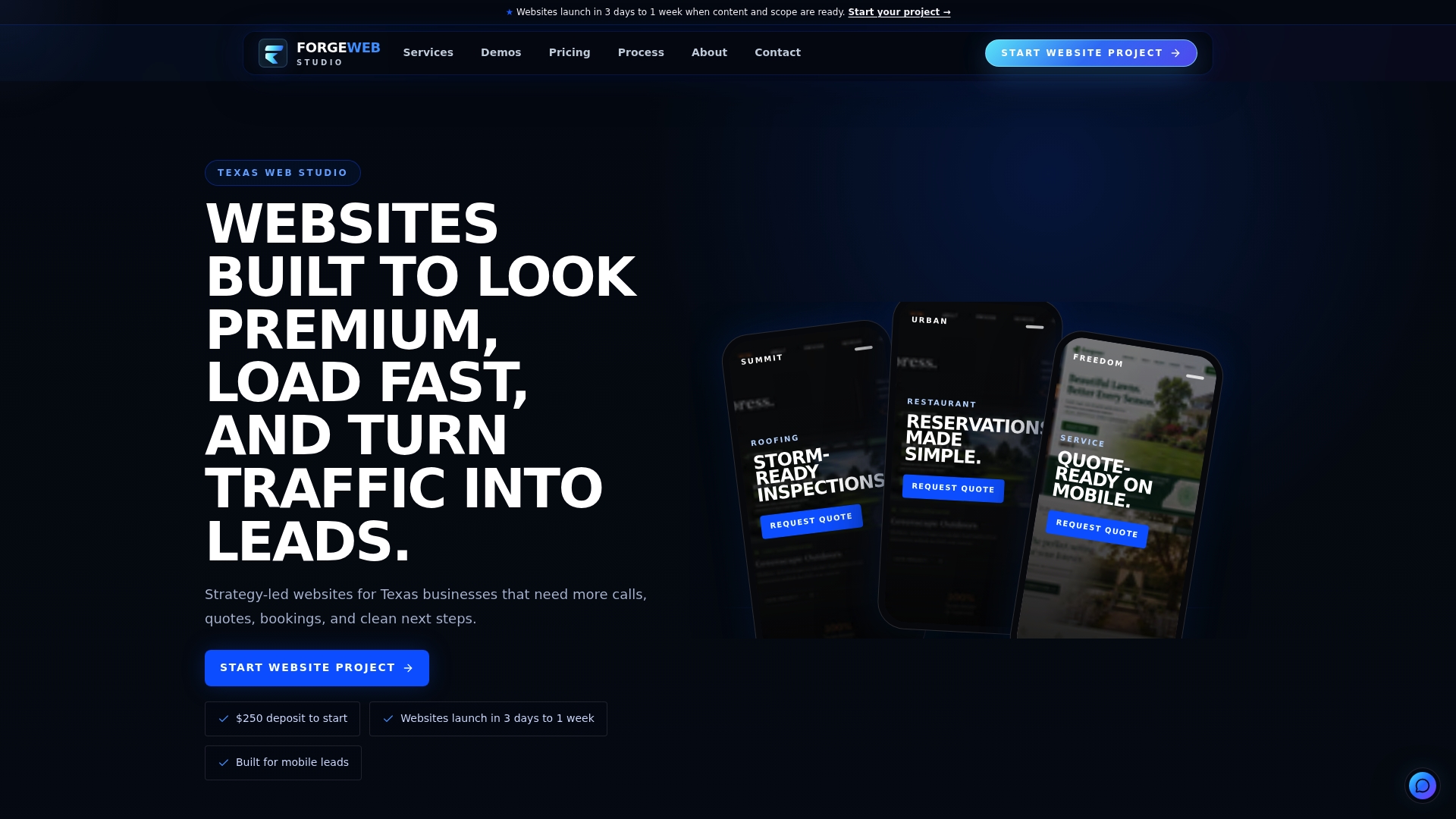
Services include responsive website design, local SEO setup, landing page builds, and Google Business profile optimization. Every project launches in three days to a week, so you are not waiting months to get the owned layer live. If you are ready to pair a strong Google presence with a site that actually captures leads, see what Forge-web-studio offers and start with a quick project scoping call.
Sources
The sources below are the definitive references for anyone implementing or evaluating Business Messages.