
A professionally built landing page in the U.S. can range from a basic template edit to a full conversion-focused launch system encompassing research, copy, integrations, and variant testing. Most small businesses running paid ads land somewhere in the $1,500–$3,500 range when they need strategy, copywriting, design, development, and tracking all included, according to Brand House's small-business budgeting guidance. The single best next step: pick your build method based on your traffic volume and offer value, then use the scope checklist in Section 8 to collect comparable quotes.
Table of Contents
- How much does a landing page cost by build method?
- What actually drives the price of a landing page up or down?
- How do vendors charge, and what are realistic hourly rates?
- What should a landing page quote actually include?
- Sample budgets for basic, mid-range, and conversion-focused pages
- How long does a landing page take to build?
- How to request comparable quotes: scope checklist and vendor questions
- Hidden and ongoing costs you need to budget for
- How Forge-web-studio prices landing pages and what you get
- Key Takeaways
- The pricing mistake most buyers make (and how to avoid it)
- Get a scoped landing page quote from Forge-web-studio
- Useful sources and further reading
How much does a landing page cost by build method?
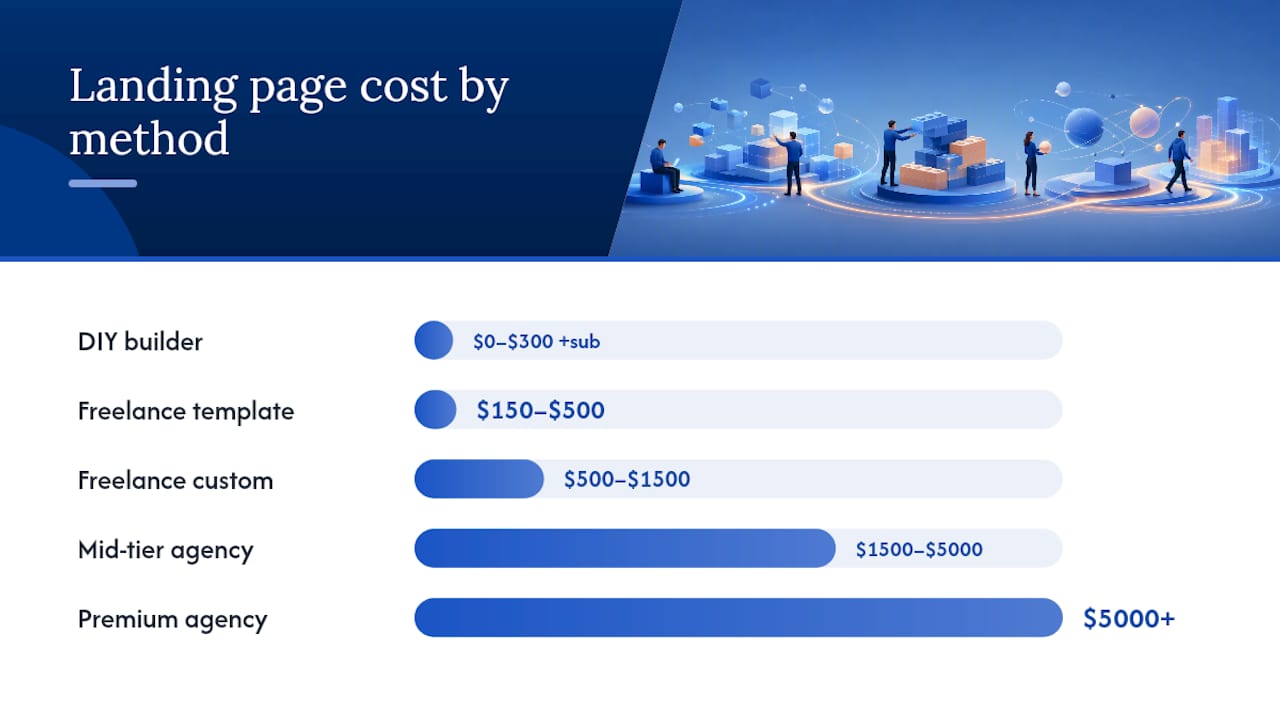
The method you choose sets the floor and ceiling of your budget before a single design decision gets made. Here is how the five main routes stack up.
| Build Method | Typical Price Range | Best For |
|---|---|---|
| DIY page builder (template) | $0–$300 + $50–$200/mo | Low-traffic tests, early-stage offers |
| Freelance template edit | $150–$500 | Simple campaigns, tight budgets |
| Freelance custom design | $500–$1,500 | Growing businesses, mid-traffic campaigns |
| Mid-tier agency | $1,500–$5,000 | Paid-traffic campaigns needing strategy + tracking |
| Premium agency / custom dev | $5,000+ | High-spend launches, multi-variant systems |
Sources: Twine Blog, projectcostestimator.com, Onyxarro
DIY page builders (Unbounce, Leadpages, Carrd) cost almost nothing upfront but carry a monthly subscription and a real time cost. You are the designer, the copywriter, and the QA tester. For a $29/month offer with 200 visitors a month, that is fine. For a Google Ads campaign burning $3,000 a month in spend, a template you built in an afternoon is a liability.
Freelance template edits sit in the $150–$500 range and make sense when you already have copy and just need someone to assemble the page cleanly. The risk is that "template edit" means different things to different freelancers. One person's edit is a color swap; another's is a full layout rebuild.
Freelance custom work at $500–$1,500 gets you an original design, usually on a builder platform, with some copywriting or at least copy guidance. Median freelance cost on common platforms runs around $900, per projectcostestimator.com's benchmark data. That median hides a wide spread, so scope matters more than the number.
Mid-tier agencies bundle strategy, design, build, and tracking into packages typically priced $1,500–$5,000. You get a team, a process, and usually a revision structure. The median agency engagement runs around $1,900 for a single page. What you are paying for above the freelance rate is accountability and a defined deliverable list.
Premium agency and custom dev work starts at $5,000 and climbs fast when you add research, multiple variants, CRM routing, event tracking, and post-launch CRO. These builds make sense when your ad spend is high enough that a 2–3% conversion lift pays back the build cost within weeks.
Pro Tip: A template beats custom when your campaign is a test. If you are spending under $1,000/month in ads and have not validated the offer yet, start with a builder. Once the offer converts, invest in a custom build that can be properly tracked and iterated.
What actually drives the price of a landing page up or down?
Knowing the price bands is useful. Knowing what pushes a $900 page to $3,000 is more useful. These are the real levers.
Copywriting and messaging strategy is the single biggest variable most buyers underestimate. A page with a tested headline, a clear value proposition, and a structured argument costs more to produce than a page with placeholder text. Conversion-focused copy from a specialist adds $300–$800 to a project, but it moves the needle more than any visual upgrade, as Twine's pricing analysis notes.
- Stakeholder reviews and asset sourcing: — If your internal approval process involves three rounds of feedback from five people, that is a scope item. So is hunting down brand assets, fonts, and photography that should have been ready at kickoff.
Pro Tip: For paid-traffic campaigns, put your budget into headline testing and event tracking before you spend on animation or custom illustrations. A better headline with proper conversion tracking will outperform a beautiful page that cannot tell you what is working.
How do vendors charge, and what are realistic hourly rates?
Two pricing models dominate: fixed-price and hourly. Each has a context where it works better.
Fixed-price engagements give you a defined deliverable for a defined cost. You know what you are getting and what it costs before work starts. The risk is scope creep: anything outside the written spec becomes a change order. Fixed-price works best when you can describe the page clearly before the project starts, which means finalized copy, a clear conversion goal, and agreed-upon integrations.
Hourly engagements give the vendor flexibility to solve problems as they emerge. They work well for exploratory or iterative projects where the final scope is genuinely unclear. The risk is that a 20-hour estimate becomes 40 hours without a budget cap in the contract.
Typical U.S. hourly rates for landing page work in 2026
| Experience Level | Hourly Rate (U.S.) | Notes |
|---|---|---|
| Entry-level / offshore | $25–$50/hr | Template work, basic builds |
| Mid-level freelancer | $55–$110/hr | Custom design + build, some strategy |
| Senior / UI-UX specialist | $85/hr | Conversion-focused, full strategy |
| Agency blended rate | $100–$200/hr | Team overhead included |
Freelance hourly rates vary significantly by region and specialization. Senior UI/UX specialists in the U.S. command higher rates than equally skilled practitioners in Eastern Europe or Latin America, where strong value is available at lower price points.
Worked example: A mid-tier freelancer quotes 30–50 hours at $85/hour. That puts the project at $2,550–$4,250 before any add-ons. If the quote says "approximately 30 hours" with no cap, get a not-to-exceed number in writing before you sign.
Pro Tip: Always ask for three things in writing before signing an hourly contract: a time estimate, a budget cap (not-to-exceed), and milestone deliverables tied to payment. Without all three, an hourly engagement has no natural stopping point.
What should a landing page quote actually include?
A quote that lists only "design and development" is not a quote. It is a placeholder. Here is what a complete proposal covers.
Deliverables checklist
- Copywriting or copy review (headline, subheads, body, CTA)
- Hero section with tested headline variant
- Full responsive layout (mobile, tablet, desktop)
- Analytics and conversion tracking setup (Google Analytics 4, Google Tag Manager)
- Form wiring and submission confirmation
- Third-party integration connections (CRM, email platform, payment)
- Cross-browser and device QA testing
- Defined revision rounds (number and scope)
- Code/asset ownership and handoff documentation
- Post-launch support window (even if just 30 days)
Red flags in a proposal
Watch for these and push back before signing:
- No mention of analytics or conversion tracking
- No mobile testing or responsive QA listed
- Ownership of code and assets is vague or absent
- Revision rounds are unlimited (a sign the vendor has not scoped the project)
- Copy is listed as "client-provided" with no review or guidance offered
- No handoff documentation or post-launch support window
Ask directly: "Who owns the code after launch? What tracking is implemented and who sets it up? How many revision rounds are included, and what counts as a revision?"
Hidden costs commonly push budgets 1.5×–3× beyond the quoted build price when items like tracking, integrations, and copy are not explicitly scoped. Quotes that exclude key elements like tracking, integrations, and copy frequently lead to substantially higher final project costs than initially anticipated.
Sample budgets for basic, mid-range, and conversion-focused pages
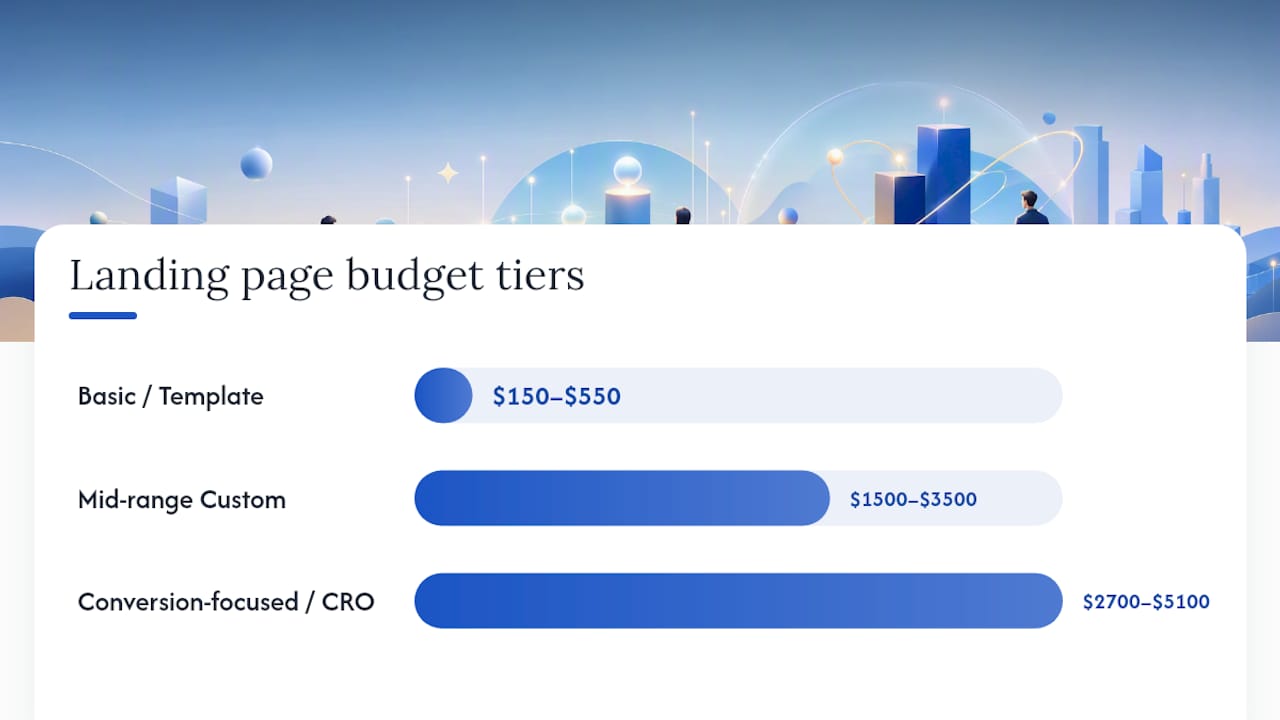
Three tiers cover most business situations. Match the tier to your traffic volume and offer value, not to your gut feeling about what a page "should" cost.
| Line Item | Basic / Template | Mid-Range Custom | Conversion-Focused / CRO |
|---|---|---|---|
| Design | $0–$150 | $300–$600 | $600–$1,200 |
| Development / build | $150–$300 | $400–$800 | $800–$1,500 |
| Copywriting | $0 (DIY) | $300–$500 | $500–$900 |
| Analytics + tracking | $0–$100 | $150–$300 | $300–$500 |
| Integrations | $0 | $150–$300 | $300–$600 |
| QA + testing | $0 | $100–$200 | $200–$400 |
| Total estimate | $150–$550 | $1,500–$3,500 | $2,700–$5,100 |
Basic / template tier ($150–$550): A page assembled from an existing template with minimal customization. No original copy, no custom tracking, no integrations. Use this for low-traffic tests or offers you have not validated yet.
Mid-range custom ($1,500–$3,500): An original design with professional copy, proper analytics, and at least one CRM integration. This is the right tier for most small businesses running paid ads at $1,000–$5,000/month in spend. Brand House's guidance puts the realistic small-business budget at $1,500–$3,500 when full strategy and tracking are required, which is the figure you should use for mid-range custom builds.
Conversion-focused / CRO ($2,700–$5,100): A page built around a testing plan, with variant infrastructure, full event tracking, and copy written to a specific audience segment. Justified when your ad spend is high enough that a 3% conversion lift pays back the build cost quickly. On a campaign driving 5,000 visitors a month at a $50 average order value, a lift from 2% to 5% conversion means 150 additional conversions per month. At that volume, a $4,000 build pays for itself in weeks.
How long does a landing page take to build?
Timeline and cost are connected. Compressed timelines almost always cost more.
| Project Path | Typical Duration | Key Milestones |
|---|---|---|
| Template setup (DIY or freelance) | 1–5 days | Brief → template selection → content drop → QA |
| Custom design + build | 2–4 weeks | Brief → wireframe → design → build → QA → launch |
| CRO build with testing setup | 4–8 weeks | Strategy → copy → design → build → tracking → variants → launch |
| Rush / 48–72 hour delivery | 2–3 days | Requires finalized copy + assets at kickoff |
A rush delivery in 48–72 hours is real, but it comes with a narrower scope. Expect a template-based build, client-provided copy, and minimal QA. Forge-web-studio's rapid build model (3 days to one week) sits in this category for businesses that have their content ready and need a clean, mobile-first page live fast.
Rush fees typically add 25–50% to the base project cost. Whether that premium is worth it depends entirely on what the page is waiting for. If you have a campaign going live Monday and it is Thursday, the math is simple.
Three things that speed any delivery: finalized copy handed over at kickoff, all brand assets (logo, fonts, colors, photography) in one folder, and a single decision-maker who can approve without a committee.
How to request comparable quotes: scope checklist and vendor questions
Collecting three quotes and comparing the totals tells you almost nothing if the scopes are different. Here is how to get proposals you can actually compare.
Scope checklist to include in every RFP
- Campaign goal (lead capture, product sale, event registration, demo request)
- Traffic source (Google Ads, Meta Ads, organic, email)
- Monthly visitor estimate or ad spend budget
- Primary conversion action (form submit, phone call, purchase)
- Required integrations (CRM name, email platform, payment processor)
- Device and locale requirements (mobile-first, bilingual, specific regions)
- Number of revision rounds expected
- Code and asset ownership requirements (you own everything at handoff)
- Performance targets (page load time, Core Web Vitals targets)
- Testing expectations (A/B variants, heatmaps, session recording)
Exact questions to ask every vendor
- What is included in a revision? Does a revision cover copy changes, layout changes, or both?
- Who owns the code and design files after launch?
- What analytics and tracking do you set up, and how is it documented?
- Is copywriting included, and if so, how many rounds of copy review?
- What integrations are included, and how are post-launch integration issues handled?
- What is your QA process, and which devices and browsers do you test on?
- Do you provide a post-launch support window, and what does it cover?
- What is your process if the project runs over the estimated hours?
Sample outreach email
Subject: Landing page quote request — [Your Business Name]
Hi [Vendor Name],
I am looking for a quote on a custom landing page for a [Google Ads / Meta Ads] campaign. Here is the scope:
Goal: [lead capture / demo request / purchase] Traffic: approximately [X] visitors/month from [paid search / social] Integrations needed: [HubSpot / Mailchimp / Stripe] Timeline: launch by [date] Ownership: I need full code and asset ownership at handoff
Please include line-item pricing for design, build, copy, tracking setup, and QA. Let me know what revision rounds are included and how you handle scope changes.
Thanks, [Your Name]
Using this template with every vendor you contact means you are comparing the same scope, not three different interpretations of "a landing page."
Hidden and ongoing costs you need to budget for
The build price is the beginning of the budget, not the whole thing. These recurring and hidden items catch buyers off guard regularly.
- Page builder or hosting subscription: Unbounce starts at $99/month. Leadpages runs $49/month. A custom-hosted page on a VPS costs $10–$40/month plus maintenance. Platform-level apps and builder subscriptions commonly involve monthly fees and per-page charges, and these add up across a campaign portfolio.
Annual cost example: A mid-range custom page at $2,000 build cost, plus $99/month for Unbounce, plus $39/month for Hotjar, plus $29/month for ActiveCampaign, adds up to $2,000 + $2,004 in annual subscriptions = $4,004 in year one before ad spend.
Pro Tip: Add a 20% contingency line to every landing page budget. Unscoped items, extra revision rounds, and integration surprises are not exceptions. They are the rule. A $2,500 project with a $500 buffer is a realistic budget; a $2,500 project with no buffer is a wishful one.
How Forge-web-studio prices landing pages and what you get
Forge-web-studio builds landing pages for Texas businesses with a focus on mobile-first layouts, lead capture flows, and local search signals. The studio's model is project-based with fixed scopes, which means no hourly surprises and a clear deliverable list before work starts.
| Package | Deliverables | Starting Price |
|---|---|---|
| Rapid landing page | Mobile-first layout, contact/booking form, basic tracking, 2 revision rounds | From $800 |
| Custom campaign page | Original design, conversion copy, GA4 + GTM setup, CRM wiring, 3 revision rounds | — |
| Google Ads landing page | Ad-matched headline, conversion-focused layout, full tracking, A/B variant ready | — |
| Full lead-gen build | Strategy, copy, design, build, integrations, QA, post-launch support | From $3,500 |
All packages include full code and asset ownership at handoff. Forge-web-studio does not lock clients into proprietary platforms or charge ongoing platform fees for pages it builds on your own hosting. Post-launch support is included for 30 days on every project.
What clients should prepare for a fast quote:
- Campaign goal and primary conversion action
- Traffic source and estimated monthly visitors
- Required integrations (CRM, email, payment)
- Brand assets (logo, colors, fonts, any existing photography)
- Copy draft or key messages (even rough notes accelerate delivery)
For businesses in San Antonio, Austin, and across Texas, Forge-web-studio's landing page services are built around the specific needs of local service providers: clear contact paths, trust signals, mobile clarity, and Google Business integration where relevant. The demo gallery shows live examples across industries so you can assess quality before requesting a quote.
Key Takeaways
Landing page cost in the U.S. ranges from $150 for a basic template edit to $5,000+ for a conversion-focused build, and the right tier depends on your traffic volume and offer value, not your preference for a lower number.
| Point | Details |
|---|---|
| Price range by method | Template edits run $150–$500; freelance custom $1,500–$3,500; agencies $1,500–$5,000+. |
| Hidden costs multiply budgets | Unscoped tracking, copy, and integrations commonly push budgets 1.5×–3× above the initial quote. |
| Match tier to traffic | A $150 template is fine for a test; a $1,500–$3,500 build is right for small businesses running paid ads; a $2,700+ build is justified when ad spend is high enough for conversion lift to pay it back fast. |
| Scope before you quote | Use the checklist in Section 8 to collect line-item proposals you can actually compare across vendors. |
| Forge-web-studio for Texas businesses | Fixed-scope landing page builds starting from $800, with full ownership handoff and 30-day post-launch support. |
The pricing mistake most buyers make (and how to avoid it)
The most common error is treating the build cost as the only cost. A business owner sees a $900 freelance quote, compares it to a $3,500 agency quote, and picks the $900 option because the math looks obvious. Three months later, they have spent $600 on revision rounds, $400 on a tracking setup they had to hire someone else to fix, and $200 on a CRM integration that was never in scope. The $900 page cost $2,100.
The second mistake is buying a cheap template for a high-traffic paid campaign. If you are spending $5,000 a month on Google Ads and sending traffic to a page you built in an afternoon, the page is the weakest link in your funnel. A 1% improvement in conversion rate on 3,000 monthly visitors at a $200 average order value is $6,000 in additional monthly revenue. The math for a proper build is not complicated.
Two rules that prevent most scope creep: require finalized copy before design starts (this alone eliminates the most common revision spiral), and set a testing plan before the page is built rather than after. A page built without a testing plan is a page that will never be properly iterated.
One pro tip for decision-makers evaluating quotes: ask every vendor what their process is when the project runs over the estimated hours. The answer tells you more about how they work than their portfolio does.
Pro Tip: When comparing proposals, divide the total cost by the number of monthly visitors your campaign will send. A $3,000 page sending 5,000 visitors a month costs $0.60 per visitor in amortized build cost. A $900 page sending 500 visitors a month costs $1.80 per visitor. The expensive page is often the cheaper one.
Get a scoped landing page quote from Forge-web-studio
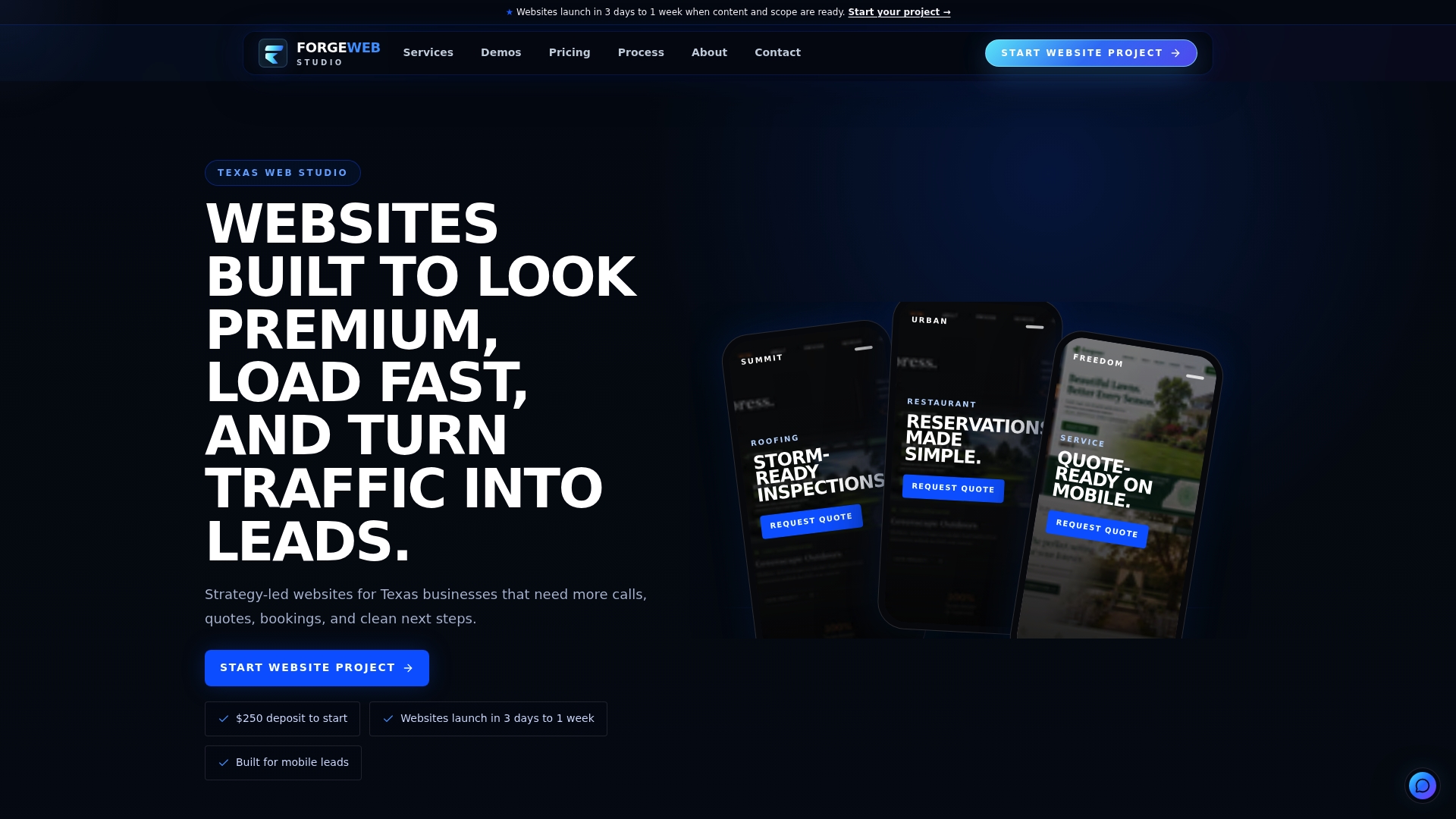
Texas businesses running paid ads or local campaigns deserve a landing page built to convert, not a template assembled in an afternoon. Forge-web-studio delivers fixed-scope, mobile-first landing pages with full ownership handoff, typically live within 3 days to one week when copy and assets are ready at kickoff. No platform lock-in, no hourly surprises, and no revision ambiguity.
The fastest way to get a comparable quote is to use the scope checklist from Section 8 and send it directly. Forge-web-studio's team reviews every request and returns a line-item proposal within one business day. You can also browse the demo gallery to see live examples before committing to anything.
Ready to move? Visit the landing pages service page to request a scoped quote or a free website direction call. Bring your campaign goal, your traffic source, and a rough sense of your budget. The rest takes about 15 minutes.
Useful sources and further reading
The figures and guidance in this article draw from the following sources. Each is worth reading in full if you want to dig deeper into a specific area.
| Source | What It Covers |
|---|---|
| Twine Blog: Custom Landing Page Cost | Freelance price bands ($150–$3,000+), copy and integration pricing, hourly rate context |
| webvise: Landing Page Cost 2026 | Business-focused tier map from DIY builder to launch system; paid-traffic scope guidance |
| projectcostestimator.com: Template vs Custom 2026 | Median freelance ($900) and agency ($1,900) benchmarks; break-even and ROI guidance |
| projectcostestimator.com: Pricing Guide 2026 | Hidden cost multipliers (1.5×–3×); practitioner scope warnings |
| Onyxarro: Scope, Cost, Timeline | Agency pricing tiers and fixed-price package examples |
| Brand House: How Much Does It Cost? | Small-business budgeting ($1,500–$3,500) for full-strategy builds |
| G2: Unbounce Reviews | User-review context on page-builder tools and conversion performance |
| Shopify App Marketplace | Platform subscription and per-page fee context for builder ecosystems |
Internal Forge-web-studio resources:
- How Much Does a Custom Landing Page Cost? - Twine Blog
- Landing Page Cost in 2026: What You Should Actually Pay - webvise
- Landing Page Cost: $300-$3,000 (Template vs Custom 2026)
- Landing page pricing guide 2026 - ProjectCostEstimator (blog)
- Landing Page Design Services: Scope, Cost, Timeline | Onyxarro
- How Much Does It Cost to Build a Landing Page? - Brand House
- apps.shopify.com
- g2.com