
NAP consistency means your business Name, Address, and Phone number appear identically across every important online listing, from Google to Yelp to your own website footer. If they don't match, search engines and customers both notice.
Do these three things in the next ten minutes: verify your Google Business Profile details, check your website header and footer against them, and open a single spreadsheet to log what you find. Those three data sources carry the most weight with search engines and shoppers, so they come first.
- Verify Google Business Profile — confirm the name, address, and phone match your official records exactly.
- Check your website — header, footer, and contact page should mirror your Google listing word for word, digit for digit.
- Start a tracking spreadsheet — one row per listing, so you can see every mismatch at a glance.
Citations sit among the top five local ranking factors, according to Moz, which is exactly why these three checks come before anything else on the list.
Key Takeaways
Nap consistency works because it gives search engines and customers one unambiguous version of your business to trust, rank, and call.
| Point | Details |
|---|---|
| Match core data first | Focus on identical phone number, address, and business name; ignore harmless formatting differences. |
| Google Business Profile is the anchor | Treat it as your master NAP and match your website and directories to it exactly. |
| Fix urgent mismatches immediately | Wrong phone numbers and old addresses cause entity splitting and lost customers. |
| Use call-tracking carefully | Keep tracking numbers on paid ads only and document the mapping separately. |
| Audit quarterly, monthly if multi-location | Assign one clear owner and recheck immediately after any contact change. |
| Get a done-for-you cleanup | Forge-web-studio offers a focused NAP audit and fix plan instead of a recurring subscription. |
Table of Contents
- What NAP Consistency Actually Requires
- Why Nap Consistency Drives Rankings and Revenue
- How Precise Does Your NAP Need to Be?
- The NAP Mistakes That Show Up Most Often
- Step-by-Step: Auditing Your Nap Consistency
- Manual Checking vs. Automated Citation Tools
- Turning Your Audit Into Fixed Listings
- How Often Should You Recheck Your Listings?
- A 30-Minute Nap Consistency Audit You Can Run Today
- What Fixing NAP Actually Changes for a Business
- Get Your Listings Fixed Without a Recurring Subscription
- Sources
What NAP Consistency Actually Requires
NAP stands for Name, Address, and Phone number, the three data points search engines use to confirm your business is real and locate it correctly. A newer variant, NAP+W, adds your website URL to that trio, since search engines increasingly cross-reference your domain alongside your contact details.
A local citation is any online mention of your NAP, whether or not it links back to your site. Citations come in several flavors:
- Directories — Yelp, Yellow Pages, industry-specific listing sites.
- Review platforms — Google reviews, Facebook reviews, niche review sites.
- Data aggregators — services that feed your NAP to dozens of smaller directories at once.
- Social profiles — Facebook Business, LinkedIn, Instagram business info.
- Maps and GIS platforms — Google Maps, Apple Maps.
- Backlinks — press mentions, chamber of commerce pages, sponsorship listings.
You'll typically find your NAP scattered across Google Business Profile, Yelp, Facebook Business (Meta Business Profile), Apple Maps, Bing Places, and whatever directories are standard in your industry. Each one is a chance for a typo, an old phone number, or a forwarding address to creep in.
Why Nap Consistency Drives Rankings and Revenue
Search engines build a profile of your business from every mention they find online, a process sometimes called entity resolution, explained in detail at How Local Search Rankings Work for Business Owners. When your name, address, and phone number match everywhere, Google can confirm you're a legitimate, stable business and rank you with more confidence in the Local Pack. When they don't match, Google has to guess which version is correct, and it often hedges by ranking you lower or splitting your business into two separate entities entirely.
Citation consistency directly affects visibility and customer conversions, and the business impact goes well beyond rankings:
- More calls and foot traffic when contact details are correct everywhere a customer might find you.
- Fewer confused or lost customers, especially those relying on voice assistants that read a single address aloud.
- Higher conversion rates from local searches, since shoppers act fastest on the first accurate result they see.
BrightLocal notes that consistent NAP data supports mapping accuracy and voice search reliability, which matters more every year as customers ask their phones to find a business instead of typing a search themselves.
Picture a customer who calls the number listed on an old directory, gets a disconnected line, and books your competitor instead. Or someone who follows a GPS pin to an address you moved away from two years ago. Neither customer complains to you. They just don't show up, and you never know why.
How Precise Does Your NAP Need to Be?
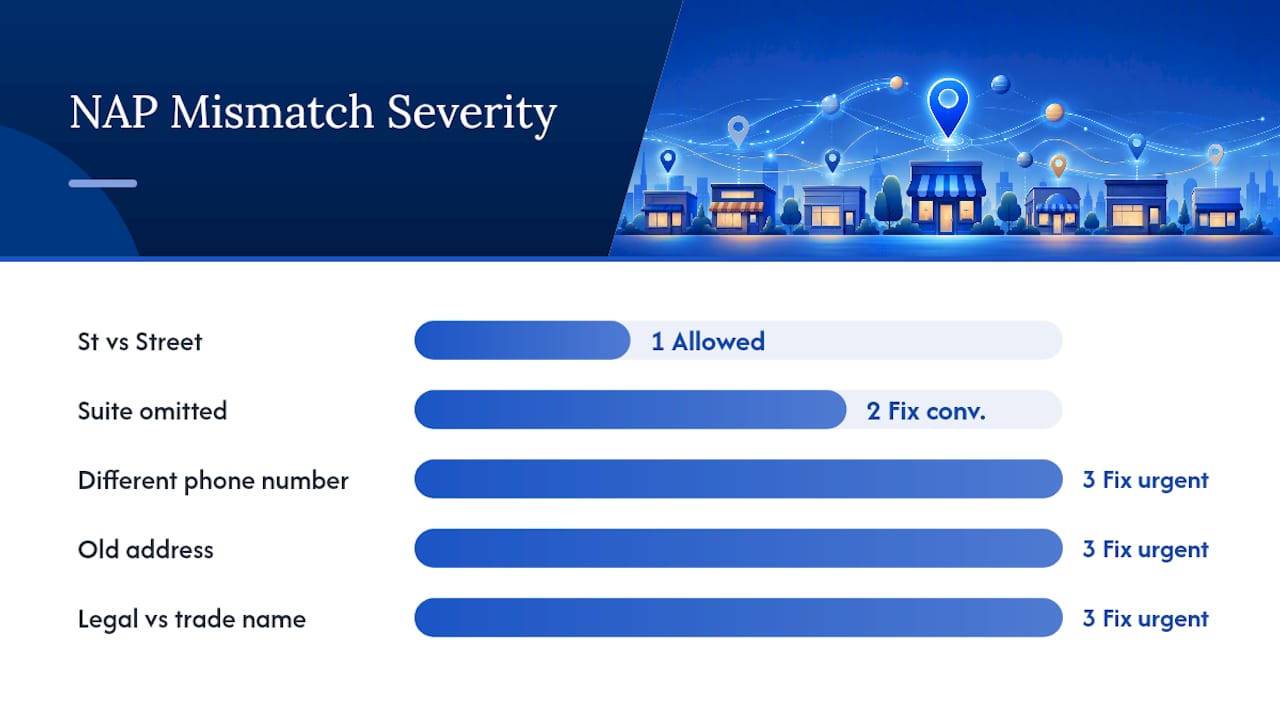
Not every discrepancy is a fire to put out. Search engines tolerate minor formatting differences like "St" versus "Street" or a missing comma, because the underlying data still points to the same place and the same phone line. What actually damages your visibility is a mismatch in the core facts: a different phone number, a different street address, or a business name that doesn't resemble your real one.
Pro Tip: Pick one "master NAP," the exact wording you'll use everywhere, and treat every other version as something to correct rather than tolerate. Consistency isn't about matching punctuation; it's about eliminating any version a search engine or customer might mistake for a different business.
| Type of difference | Verdict |
|---|---|
| "St" vs "Street", minor punctuation | Allowed, no action needed |
| Suite number omitted on a minor directory | Fix when convenient |
| Different phone number listed | Fix urgently |
| Old address from a previous location | Fix urgently |
| Legal name vs. trade name shown inconsistently | Fix urgently |
The NAP Mistakes That Show Up Most Often
A handful of issues account for most of the damage auditors find, and they tend to repeat across industries.
- Old phone numbers left over from a previous location or a discontinued call-tracking line.
- Duplicate Google Business Profile listings, often created when a new manager or agency set one up without checking for an existing one.
- PO box or virtual office addresses used inconsistently with the physical storefront address.
- DBA and legal name mismatches, where some listings use "Smith Plumbing LLC" and others use "Smith Plumbing Co."
- Formatting drift across directories that were never updated after a rebrand.
- Aggregator errors, where a single bad data feed propagates a mistake to dozens of smaller sites automatically.
A business that moved locations two years ago can still have its old address live on a dozen minor directories that pulled data from an aggregator once and never refreshed it. The fix isn't updating the directories one by one; it's correcting the aggregator feed so the error stops spreading.
If you use call-tracking numbers for advertising, don't let them bleed into your public listings. Ahrefs recommends keeping tracking numbers confined to paid channels while your Google Business Profile, website, and directories all display your real, consistent number, with the tracking mapping documented separately.
Step-by-Step: Auditing Your Nap Consistency
Work through these sources in order of influence, not alphabetically:
- Google Business Profile. This is the source search engines trust most, so confirm it first and treat it as your master record.
- Your website. Check the header, footer, and contact page for exact matches to your Google Business Profile.
- Major directories. Yelp, Apple Maps, and Bing Places carry outsized weight because search engines and voice assistants query them directly.
- Review platforms. Facebook Business, industry-specific review sites, and anywhere customers might have added your business manually.
- Data aggregators and smaller directories. These often source their listings from feeds, so errors here point to a bigger upstream problem.
Log everything in a spreadsheet with these columns:
| Column | Purpose |
|---|---|
| Master NAP | The correct, canonical version you're comparing against |
| Source | Which platform the listing appears on |
| URL | Direct link to the listing |
| Discrepancy type | Formatting, phone, address, or name mismatch |
| Priority | Urgent fix vs. low priority |
| Last checked | Date of your most recent review |
Fix Google Business Profile and your own website first, since those carry the most authority. Then move to high-traffic directories and aggregators. Claim any unclaimed listings you find, correct wrong data, and flag duplicates for removal rather than trying to edit two listings for the same location simultaneously.

Manual Checking vs. Automated Citation Tools
Checking citations by hand costs nothing but your time, and it's precise: you see exactly what's live right now on each platform. The trade-off is scale. If your business has locations in five cities, manual checking turns into a part-time job.
Moz's own local ranking factor research groups these into listing finders, citation managers, and call-tracking platforms, and mixing up the category is a common mistake. CallRail solves attribution, not NAP cleanup, so pair it with a citation tool rather than expecting it to fix directory listings.
Pro Tip: A paid citation service earns its keep when you manage multiple locations or your contact details change often. A single stable location usually needs one thorough cleanup, not a permanent subscription.
Turning Your Audit Into Fixed Listings
Once your spreadsheet is built, work the fixes in this order:
- Claim and verify every unclaimed profile you found during the audit.
- Correct Google Business Profile first, since it's your source of truth.
- Update your website's contact markup, including any structured data.
- Fix major directories next: Yelp, Apple Maps, Bing Places, Facebook Business.
- Correct data aggregators, which prevents the same error from reappearing later.
- Request duplicate removals for any doubled-up listings you flagged.
For your website, add JSON-LD schema markup with these fields set to match your master NAP exactly:
name— your official business name, no abbreviations that differ from Google Business Profile.address— structured street, city, state, and zip fields, not a single text block.telephone— your public number, formatted consistently.sameAs— links to your verified social and directory profiles.url— your website's canonical address.
If you run call-tracking numbers on ads, keep them off your public listings entirely and document the mapping in your spreadsheet so nobody accidentally publishes a tracking number as your main line.
A realistic timeline for a single-location business: Google Business Profile and website fixes in a day, major directories corrected within a week, aggregator corrections and duplicate removal requests resolved within a month.
How Often Should You Recheck Your Listings?
A stable, single-location business can get away with a quarterly check. Multi-location businesses, or anyone whose contact details change frequently, should audit monthly instead. Any time you change your address, phone number, or legal name, review your listings immediately rather than waiting for the next scheduled check.
Assign ownership clearly: one person, whether that's the marketing manager or the owner, keeps the spreadsheet current, with an agency or consultant as backup. Store it somewhere permanent, a shared spreadsheet or your CRM, not a document buried in someone's inbox.
Rebrands, moves, phone changes, acquisitions, and repeated customer complaints about wrong contact info are all triggers for an unscheduled audit, regardless of where you are in your normal cycle.
A 30-Minute Nap Consistency Audit You Can Run Today
Here's a compact version of the spreadsheet template we use with clients:
| Master NAP | Source | Discrepancy | Priority | Last checked |
|---|---|---|---|---|
| Smith Plumbing, 123 Main St, Suite 4, (512) 555-0142 | Yelp | Missing suite number | Fix urgently | 2026 |
Run this in 30 minutes:
- Open Google Business Profile and confirm every field matches your master NAP.
- Open your website's footer and contact page in a second tab and compare line by line.
- Search your business name on Google and click into the first five directory results.
- Log any mismatch immediately, marking phone and address errors as urgent.
Forge-web-studio built a priority list of local citation sites from real client cleanup work, which is a faster starting point than guessing which of the hundreds of directories out there actually matter for your industry.
What Fixing NAP Actually Changes for a Business
Clients who clean up their listings tend to see fewer missed calls and better Map Pack visibility within weeks, not months. One recurring pattern: a business that had drifted into two competing Google Business Profile listings regained its ranking almost immediately after the duplicate was merged and the surviving listing was corrected.
The bigger shift is trust. Customers don't file a complaint when your phone number is wrong. They just call your competitor.
Get Your Listings Fixed Without a Recurring Subscription
Most stable, single-location businesses don't need an ongoing citation subscription. They need one thorough cleanup and a clear owner going forward. That's the gap Forge-web-studio fills for Texas local businesses: a focused audit and fix, not a monthly retainer you'll forget you're paying for.
Here's what that looks like in practice: a 30-minute audit of your Google Business Profile, website, and top directories, a corrected listing set, and a priority action plan ranked by impact so you know what to fix first and what can wait. If your website itself needs contact updates or schema work as part of the cleanup, that gets scoped in too.
If you'd rather have someone run the audit and hand you a finished fix list, start with local SEO services built for local businesses and get a plan scoped around your actual listings, not a generic checklist.
Sources
- What is NAP in Local SEO? - Moz
- What is NAP in SEO? - Ahrefs
- Importance of accurate name, address, phone number - BrightEdge