
Default to a brandable name if you're building something meant to grow past its first product, and a descriptive name if local clarity matters more than differentiation. Either way, your next move is the same: build a list of 20 or more available candidates today and run the radio test on your top five before you fall in love with any of them. The rest of this guide gives you the scoring checklist and the legal checks that keep a good-sounding name from becoming an expensive mistake.
TL;DR:
- Using a brandable name provides flexibility for future growth and protects against trademark conflicts, especially for expanding businesses.
- Conducting thorough legal and trademark checks before domain purchase prevents costly rebranding and confusion with existing brands.
- The radio test and paper test are quick, effective methods to identify phonetic and visual issues that could harm brand recognition and recall.
- For most small businesses, securing a .com domain is advisable due to its widespread trust and habitual use by consumers, unless targeting a specific country.
- Prioritizing clarity and legal safety when scoring final domain options ensures the chosen name supports both immediate discoverability and long-term brand protection.
Table of Contents
- How Do You Choose a Business Domain Step by Step?
- Does the TLD You Pick Actually Matter?
- Brandable vs Descriptive: Which Fits Your Business?
- What Trademark and Legal Checks Should You Run First?
- What's the Fastest Way to Validate a Domain Before Buying?
- How Do You Register and Protect a Domain Once You've Chosen It?
- What's a Simple Way to Score My Final Domain Options?
- Founder Perspective: What Domain Choice Actually Does to a Website
- If You'd Rather Skip the Guesswork, Here's How We Can Help
- Sources
- FAQ
How Do You Choose a Business Domain Step by Step?
Picking a domain name isn't one decision, it's a filter you run candidates through until only the strong ones survive. Start broad, then narrow fast.
-
Define the domain's job first. Before typing anything into a search bar, know who the name has to speak to, what tone fits your brand, and whether you're likely to expand your product line later. A plumbing company staying local for the next decade has different naming needs than a software startup planning to raise funding.
-
Generate names across four routes. Brandable (invented words like Zillow or Kodak), descriptive (AustinPlumbingPros.com), compound (two real words mashed together), and geo-modified (adding a city or region). Producing candidates across all four routes beats brainstorming in just one lane, because a filtering mindset that generates many options and ruthlessly cuts the weak ones outperforms hunting for a single perfect name.
-
Bulk-check availability, .com first. Run your list through a bulk domain search and filter down to at least 20 names where the .com is actually available. Anything less and you're negotiating with yourself before you've even started testing.
-
Run the radio test and paper test on your top five. Say each name out loud to someone who can't see it spelled out. If they mishear it, misspell it back to you, or ask "wait, one word or two?" that name is done.
-
Check social handles and key platforms. Search Instagram, X, and Facebook for your finalists. A domain that's free but paired with a handle already taken by an unrelated brand creates friction you'll deal with for years.
-
Run a USPTO knock-out search and check web history. Before you buy anything, search the exact name and close spellings. Then check the domain's past on the Wayback Machine if it was ever registered before.
-
Score what's left. Rank your finalists on clarity, recall, legal risk, room to grow, and cost, and let the numbers make the final call instead of your gut.
- Keep a shared spreadsheet so partners or co-founders can weigh in without a group text spiraling into forty conflicting opinions.
- Set a deadline. Naming decisions expand to fill the time you give them.
Pro Tip: Read your top three names in a sentence like "Welcome to [Name], how can I help you today?" out loud. If it sounds clunky as a greeting, it'll sound clunky in every voicemail and every ad your business ever runs.
Does the TLD You Pick Actually Matter?
Yes, but not evenly across every business. For most small businesses chasing a broad, general audience, .com still carries the strongest built-in trust. People type it out of habit, autofill assumes it, and customers who forget your exact URL will guess .com before they guess anything else.
That doesn't mean every alternative is a downgrade. Here's when it makes sense to look beyond .com:
- Tech and software companies often use .io or .ai, since those extensions have become shorthand for "we build software" in their own circles.
- Agencies and consultants sometimes use .agency or .co when the matching .com is locked up by a squatter or a much larger company.
- Businesses targeting one country benefit from a country-code domain (a ccTLD like .ca or .co.uk) when the goal is explicitly to signal local relevance in that market.
Google backs this up directly: most generic top-level domains, including .com, .org, .net, and newer options, are treated equally for ranking purposes, while ccTLDs function as a genuine geographic signal search engines weigh more heavily when you're targeting a specific country.
If your ideal .com is taken, you have three real paths: buy it on the aftermarket if the price is reasonable, register a strong alternative TLD and set up a permanent redirect from a secondary .com later (learn when multiple domains or TLDs are appropriate in this multi-domain SEO strategy guide), or pivot the name itself. Whatever you choose, lock down matching social handles immediately so your brand stays consistent across every extension it might live on.

Brandable vs Descriptive: Which Fits Your Business?
A brandable name is an invented or unusual word with no built-in meaning, like Sling or Kajabi. A descriptive name states exactly what you do, like SanAntonioRoofRepair.com. Neither is universally correct, it depends on what your business needs to signal on day one.
Descriptive names tend to win when:
- You run a local, single-service business where customers search by service and city.
- Immediate clarity matters more than personality (plumbers, dentists, tax preparers).
- You're not planning to expand into adjacent products or services anytime soon.
Brandable names tend to win when:
- You plan to grow beyond your first offering and don't want a name that boxes you in.
- Trademark protection matters, since invented words face far less competition at the USPTO than common descriptive terms.
- You're building toward acquisition, franchising, or multi-market expansion.
Brandable domains function as empty vessels; they carry no literal meaning yet, which means they can absorb whatever your business becomes instead of anchoring you to what it is today. That flexibility is exactly why distinctive, invented names tend to hold up better as a company scales past its original product line. If you're a single-location service business with no expansion plans, though, descriptive still wins on pure discoverability, and keyword-in-domain has little real effect on search rankings anyway, so don't force keywords in purely for SEO's sake.
What Trademark and Legal Checks Should You Run First?
Buying a domain before checking trademark conflicts is how businesses end up rebranding eighteen months after launch, after they've already printed signage and built customer recognition.
- Run a USPTO knock-out search. Search your exact proposed name in the USPTO trademark database first, then expand to similar spellings, phonetic equivalents, and closely related goods or services categories.
- Check your state's business registry. A name can clear federal trademark search and still conflict with an existing state-registered LLC or corporation using nearly identical branding.
- Search for similar-sounding marks in your industry. A name that's technically distinct but sounds close to a known competitor invites confusion and, sometimes, a cease-and-desist letter.
- Know when to call a trademark attorney. A DIY knock-out search catches obvious conflicts, but it doesn't guarantee clearance. Attorneys check nuances a keyword search misses, and the USPTO itself recommends professional help for anything beyond a preliminary screen.
Pro Tip: If your knock-out search turns up even one close match in your exact industry, don't talk yourself into "it's probably fine." Walk away. The cost of a new domain search is nothing compared to a rebrand after your first big marketing push.
Red flags that should stop a purchase outright: a nearly identical name already trademarked in your industry, a domain with an active cease-and-desist history, or a name so close to a national brand that customers could reasonably confuse the two.
What's the Fastest Way to Validate a Domain Before Buying?
You don't need focus groups or expensive research to pressure-test a name. Two old-school tests catch most problems in minutes.
- The radio test. Say the name aloud to someone who can't see it. If they can't spell it back correctly or ask you to repeat it twice, that's a real signal, not a fluke.
- The paper test. Write the name down and look at it a day later. Names that seemed clever at midnight often look cluttered or oddly spaced on paper the next morning.
- Handle consistency check. Confirm your top pick is available (or close to it) on the two or three social platforms your customers actually use.
- Domain history check. Run the name through the Wayback Machine and a WHOIS lookup to rule out a spam history or prior penalties you'd inherit.
These two tests are complementary: the radio test exposes phonetic confusion, while the paper test surfaces the visual and spacing issues that only become obvious once you've stared at the name for a while.
Pro Tip: If a name fails either test twice with two different people, don't rationalize it. A name you have to explain is a name that's already losing you customers before they reach your site.
How Do You Register and Protect a Domain Once You've Chosen It?
Registering a domain takes five minutes. Registering it safely takes a little more attention.
- Pick a reputable registrar and read the renewal pricing before you buy, not after. Rock-bottom first-year prices sometimes triple at renewal.
- Turn on WHOIS privacy so your home address and phone number aren't sitting in a public database, and enable two-factor authentication on your registrar account immediately.
- Understand that privacy protection hides your contact info from public lookups, but it doesn't hide ownership from the registrar or from legal processes.
- If you're buying a premium or auction domain from a previous owner, never wire money directly. Use an escrow service and require signed proof of control before funds change hands.
- Know that inter-registrar transfers are governed by ICANN policy, and most registrars enforce a 60 day lock after certain account or registrant changes, so plan any planned transfer well before a launch deadline.
What's a Simple Way to Score My Final Domain Options?
Once you've got two or three names that survived the tests, stop debating and start scoring. Rate each finalist from 1 to 5 across these categories, weighted by what matters most to your business:
- Clarity (does a stranger understand it instantly?)
- Radio test performance (can it be heard and spelled correctly?)
- Recall (will someone remember it a week later?)
- Distinctiveness (does it stand apart from competitors?)
- Trademark risk (how clean was the knock-out search?)
- Cost (purchase price plus realistic renewal cost)
Weight clarity and trademark risk heaviest if you're a local service business; weight distinctiveness heaviest if you're building something meant to scale. Whichever name scores highest and clears both your legal checks and your validation tests is your answer. Don't keep shopping once a name clears that bar. Descriptive names win on clarity and immediate discovery; brandable names win on differentiation and room to grow, so let your scoring weights reflect which one your business actually needs.
Founder Perspective: What Domain Choice Actually Does to a Website
Domain clarity shows up on the phone screen before it shows up anywhere else. A visitor scanning search results on a five-inch display either recognizes what your business does instantly or bounces to the next result. Clever loses to clear almost every time on mobile, especially for local service businesses where someone is searching while standing in their driveway with a leaking pipe. When we build sites fast for local clients, we push toward the name that makes navigation, contact buttons, and calls-to-action obvious over the name that sounds impressive in a pitch meeting. The domain is the first sentence of your website's conversion story, and confusing sentences don't convert.
— Dylan
If You'd Rather Skip the Guesswork, Here's How We Can Help
Picking the name is half the job. Turning it into a site that actually generates calls and leads is the other half, and that's where a lot of small businesses stall out after they've already bought the domain. Our studio builds mobile-first, lead-focused websites quickly, so the gap between "I registered a domain" and "I have a working site with real contact paths" doesn't stretch into months.
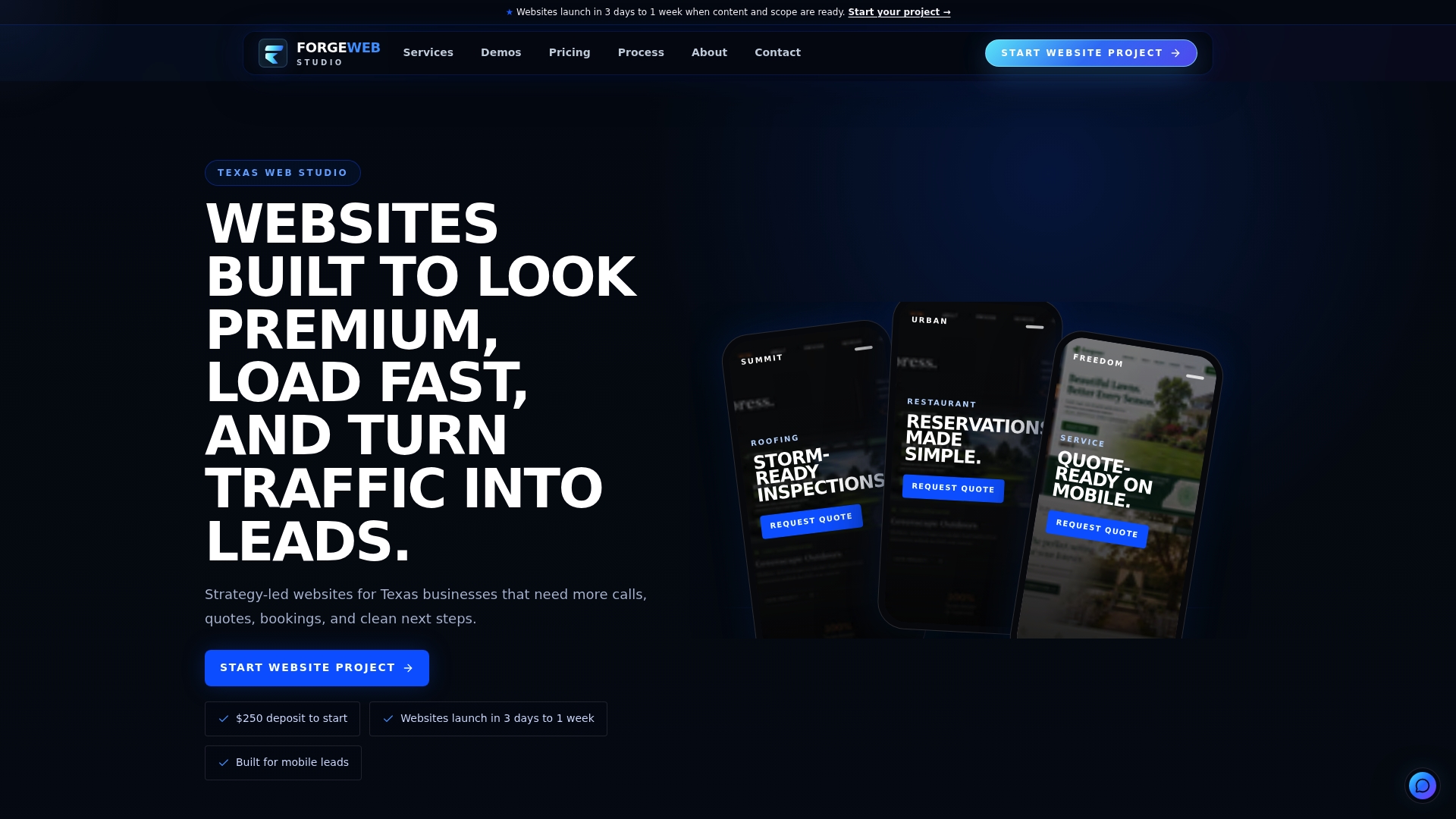
Once you've settled on a name, we handle the rest: DNS setup, clean redirects if you're consolidating from an old domain, and a launch QA pass so nothing breaks the day you go live. Our Starter Website builds start from $500, Growth Website from $1,200, and fully Custom Business Website projects from $2,500, all with transparent scope and no template shortcuts. If your current site is already live but underperforming on mobile or missing clear contact paths, our website review checklist is a good place to start before a redesign. When you're ready to move from domain to live website, request a project and tell us what you're building.
Sources
- Brandable Domain Names | BrandBucket
- Managing multi-regional and multilingual sites | Google Search Central
- Federal trademark searching | USPTO
- Registrar Transfer Policy (ICANN)
FAQ
How Do I Choose a Domain Name for My Business?
Define who the name needs to speak to, generate at least 20 candidates across brandable and descriptive routes, then filter using the radio test, a USPTO knock-out search, and social handle availability. Score your surviving finalists on clarity, recall, and legal risk before buying.
What Are the Main Types of Domain Extensions?
The most common categories are generic TLDs like .com, .org, and .net; country-code TLDs like .ca or .uk for geographic targeting; and newer specialty gTLDs like .io, .ai, or .agency built around industries. Most generic TLDs are treated equally by Google for ranking, while ccTLDs send a stronger country-targeting signal.
Should You Put LLC in a Domain Name?
Generally no. Including "LLC" adds length and clutter without adding customer value, and it makes the name harder to say out loud or remember, which fails the radio test almost every time. Save your legal entity name for contracts and invoices, and keep your domain focused on your brand or service.
Which Domain Extension Is Best for a Business?
For most small businesses targeting a general audience, .com remains the strongest choice because customers default to typing it out of habit. If your ideal .com is unavailable and you serve one specific country, a matching ccTLD can work well; if you're in tech, .io or .ai extensions carry some industry recognition, and a studio like Forge-web-studio can help you weigh the tradeoff against your actual growth plans.