
A landing page is one page built to drive one action; a website is the full multi-page hub built for discovery and multiple goals. Send paid or campaign traffic to a landing page. Send organic or brand traffic to your website. Most growing businesses need both, working together, not one instead of the other.
TL;DR:
- Paid ad traffic should be directed to dedicated landing pages to maximize conversions and maintain message consistency, while organic search traffic benefits from a comprehensive website.
- A full business website typically includes multiple pages, SEO content, and trust signals, and takes longer to develop, making it essential for long-term visibility and trust.
- Landing pages are best suited for quick campaigns or validation, with a focus on one clear action, minimal distractions, and matching the message to the traffic source.
- Sending ad traffic to the homepage instead of a targeted landing page often reduces conversion rates and inflates costs due to mismatched expectations.
- Combining both formats effectively requires understanding traffic origin, campaign goals, and budget, with microsites as a flexible middle option when more than a single page is needed.
Table of Contents
- Landing Page vs Website: What a Website Actually Does
- Landing Page vs Website: What a Landing Page Is Built For
- Landing Page vs Website Comparison: Reading the Differences
- When to Send Traffic to a Landing Page vs a Website
- How to Choose: A Practical Checklist Before You Build
- Real Patterns: How Different Businesses Actually Use Both
- How Forge-web-studio Approaches This Decision
- The Real Mistake Most Businesses Make
- Ready to Build the Right Page for Your Traffic?
- Sources
- FAQ
Landing Page vs Website: What a Website Actually Does
A website is a domain-level collection of pages, connected by navigation, built to serve several goals at once instead of one. It's where a stranger goes to figure out if you're legitimate, where a returning customer checks your hours, and where Google sends people who typed a question into search without clicking an ad.
A functional business website usually includes:
- A homepage that orients any visitor, regardless of how they arrived
- Navigation connecting service or product pages, about, and contact
- A blog or resource section that builds long-term organic visibility
- Trust signals: reviews, licenses, team photos, past work
- A contact page with multiple paths (form, phone, address, map)
Websites carry the weight HubSpot's comparison points to directly: they serve discovery, multiple audiences, and long-term search visibility, while a single landing page can't do any of that on its own. A blog post you wrote eight months ago is still pulling in search traffic today. A landing page built for a Black Friday promo is dead weight the week after Black Friday.
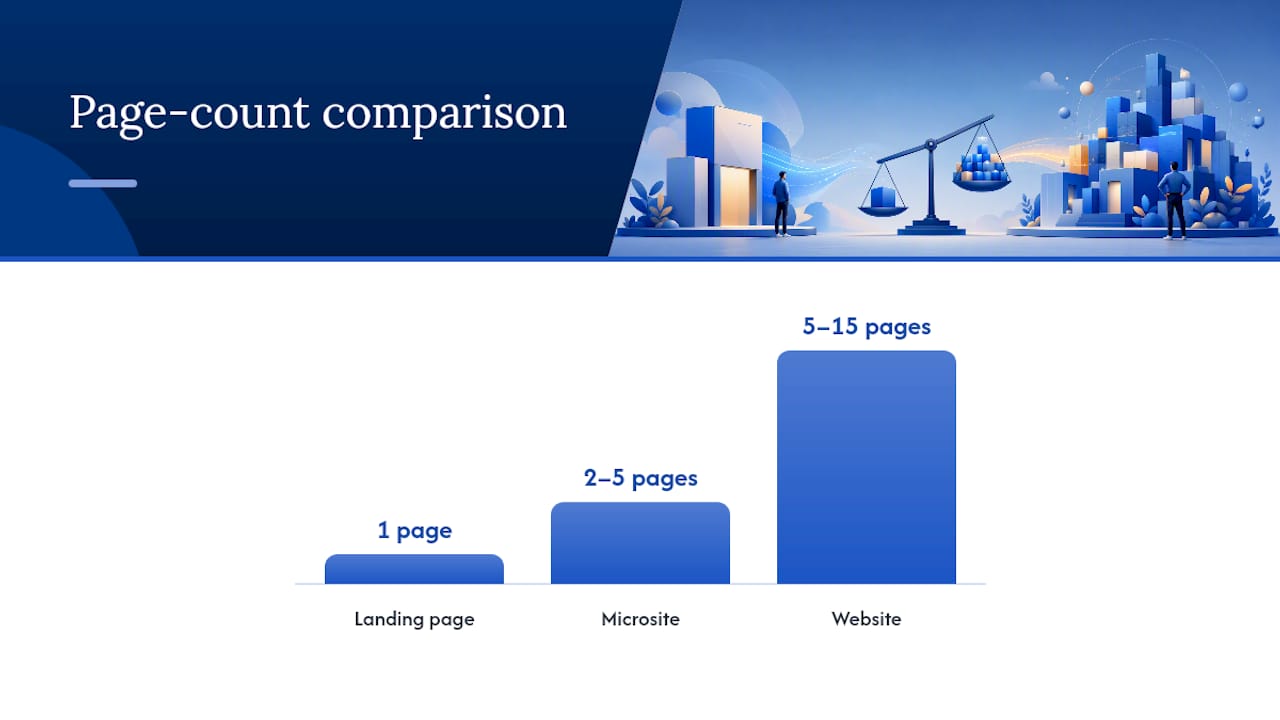
Cost and timeline vary by scope, but a real business website (five to fifteen pages, mobile-optimized, with a contact and lead flow built in) typically takes longer to plan and build than a single landing page, simply because there's more to design, write, and connect. If your business has more than one offer, serves more than one type of customer, or needs to show up in Google search results months from now, you need a website. There's no substitute for it.
Landing Page vs Website: What a Landing Page Is Built For
A landing page is a single page designed to drive one specific action, whether that's a sign-up, a download, or a purchase, with clear focus and conversion techniques explained in landing page design that converts. No main navigation. No distractions. Every element on the page points toward the same button.
The essential pieces of a strong landing page:
- One headline that matches exactly what brought the visitor there
- A single, clear offer, stated once and repeated in different words
- One call-to-action, not three competing buttons
- A form or purchase point with minimal fields
- Social proof (testimonials, logos, review counts) placed near the CTA
That last point about matching the message to the traffic source is not a small detail. Leadpages' research on landing pages versus homepages found message match between the ad or email and the landing page copy is the single biggest lever for improving campaign return. Get the headline wrong and the rest of the page barely matters.
Landing pages shine for paid ad campaigns, email promotions, product launches, and demand validation, where you want to test an offer before building anything bigger. They're also faster and cheaper to produce than a full site, since there's one page to design instead of ten.
They're the wrong tool for high-ticket, high-trust sales that need context. A $15,000 kitchen remodel or a legal retainer usually needs the credibility a full site provides, not a stripped one-pager that skips past the trust-building.
Pro Tip: If you're not sure your offer is strong enough for a full campaign, build the landing page first. It's the cheapest way to find out if anyone actually wants what you're selling before you spend on a whole site.
Landing Page vs Website Comparison: Reading the Differences
The gap between these two formats comes down to one question: is this page trying to do one thing, or many things?
| Factor | Landing Page | Website |
|---|---|---|
| Goal | One action | Multiple goals |
| Navigation | None or minimal | Full menu |
| CTAs | One, repeated | Several, varied |
| Traffic source | Paid ads, email, promos | Organic search, direct, referral |
| SEO/organic longevity | Weak, campaign-limited | Strong, compounds over time |
| Time to launch | Days | Weeks |
| Cost | Lower | Higher, scales with pages |
| Best for | Campaigns, launches, validation | Discovery, brand, long-term traffic |
Read that traffic-source row first. It matters more than any other line in the table. A landing page built for a Facebook ad campaign has one job: convert someone who's already interested. A website built for organic search has a different job entirely: it has to answer questions, build trust over months, and rank for dozens of search terms a landing page will never touch.
Here's the trap a lot of businesses fall into: they build a lean, stripped-down landing page, then try to make it their whole online presence and wonder why it never shows up in Google search results. Thin pages with one paragraph and a form don't rank. Search Engine Land's landing page guide notes that after recent Google algorithm updates, service pages with real depth, often 1,000 to 2,000 words or more, consistently outperform thin landing pages for organic search. If a page needs to earn organic traffic long term, give it the content depth of a real service page, not the bare bones of a campaign landing page.
There's a middle option worth knowing about too: a microsite. Semrush describes microsites as small clusters of two to five connected pages, sitting between a single landing page and a full website. They're a fit when a campaign needs slightly more room, say, a product launch with a features page and a pricing page, but doesn't justify building an entire site.
When to Send Traffic to a Landing Page vs a Website
Match the destination to where the visitor is coming from, not to what feels easiest to build. Here's how that plays out in practice:
- Paid search or paid social ads → Landing page. Search Engine Land's guidance points out that sending this traffic to a homepage dilutes your ad's message and can hurt Quality Score, which raises what you pay per click.
- Email campaign links → Landing page. The subject line made a promise; the page needs to deliver on that exact promise, nothing more.
- Product or service launch → Landing page or microsite, depending on how much you need to explain.
- Organic search visitors → Website, specifically a content-rich service page or blog post that answers their actual question.
- Returning visitors and brand searches → Website homepage, where they can navigate to whatever they need next.
- Event registration → A dedicated landing page for a single event; a microsite if it's a multi-day or multi-session event with several moving parts.
- Demand validation for a new idea → A landing page, built fast and cheap, before committing to a full build.
Mismatch these and you pay for it twice: once in wasted ad spend, once in a visitor who bounces because the page didn't match what they expected. Cold traffic from an ad needs the focus of a landing page; a warm returning visitor usually wants the orientation a full site provides. Send an ad click to your homepage and you're asking a stranger to find the offer themselves. Most won't bother.
How to Choose: A Practical Checklist Before You Build
Run through these questions before you brief a designer or start building anything yourself:
- Does this page need to accomplish one goal, or several? One goal points to a landing page.
- Where is the traffic coming from: paid ads, email, or organic search and referrals?
- What's your budget and timeline? A single landing page can launch in days; a full site takes longer.
- Do you need this page to rank in search results a year from now?
When you're talking to a designer or agency, ask direct questions: How is conversion tracked? Do they test more than one headline or layout? Is the site mobile-first, or mobile-adjusted after the fact? Do you own the content management system, or are you locked into their platform?
Watch for red flags. A landing page that's been stripped down for a $10,000 service with no context or credibility signals is a warning sign, not a feature. So is a page with no analytics installed, a headline that doesn't match the ad that sent someone there, or a mobile layout that was clearly an afterthought.
Pro Tip: Ask to see the mobile version before you approve anything. A page that looks sharp on a laptop and falls apart on a phone is losing you leads every single day it stays live.
Real Patterns: How Different Businesses Actually Use Both
The mix of landing pages and website pages tends to follow a business's model, not a generic template. A few patterns show up again and again:
- B2B service businesses run a core website for credibility and SEO, then spin up dedicated landing pages for each paid campaign or lead magnet.
- Ecommerce brands use a promo landing page for a flash sale or a new product drop, while the full product catalog lives on the main site.
- Event organizers build one landing page for a single event, but move to a microsite when the event spans multiple days or tracks.
- Startups often validate an idea with a single landing page. AWeber's comparison of landing pages and websites makes the case that this is the lowest-cost way to test real demand before committing to a full build, and once demand is proven, they expand into a complete site.
None of these patterns are exclusive. A restaurant might run a website for its menu and hours, then build a single landing page just for holiday catering orders.
How Forge-web-studio Approaches This Decision
Every project starts with the same question: what's the one job this page needs to do, and where is the traffic coming from? That decision shapes everything else, including how much content the page carries and how fast it needs to launch. Forge-web-studio builds toward mobile clarity and a clean lead flow first, because a page that looks right on a phone and gets someone to a contact form quickly outperforms a page that just looks polished.
The checklist we run before touching a design tool: does this need message match with a specific ad? Does it need to rank organically a year from now? Is lead tracking already in place? Those three answers decide whether you get a landing page or a full site.
The Real Mistake Most Businesses Make
If you take one rule from this, make it this: control your own traffic, send it to a landing page. Let strangers self-select through organic search, send them to your website. Most conversion problems trace back to one mismatch, usually a paid ad dumped on a generic homepage, or a $5,000 service crammed onto a page with no context. When you're not sure which one fits, run a quick A/B test. The data will tell you faster than any guess will.
— Dylan
Ready to Build the Right Page for Your Traffic?
Forge-web-studio offers a founder-led service focused on rapid website builds designed to provide ownership of sites and content without templates or surprise fees.
If you're testing an offer or launching a campaign, the landing pages for local businesses service gets you a focused, mobile-first page fast. If you need the full hub, a Starter Website starts at $500, with Growth and Custom Business builds available for more complex needs, and Local SEO sets you up to actually get found once the site is live. Not sure which one fits your situation? Request a website and get a straight answer before you spend a dollar.
Sources
Definitions, conversion benchmarks, and traffic guidance in this article draw on Semrush, HubSpot, Search Engine Land, and Leadpages.
- What Is a Landing Page? (Leadpages)
- Landing pages vs websites: What's the difference (HubSpot)
- Landing pages guide (Search Engine Land)
FAQ
Do I need a website if I have a landing page?
Yes, for most businesses. A landing page converts campaign traffic, but it can't rank long term or serve returning customers the way a full website does.
Can a landing page be a website?
Technically, a single landing page can serve as a temporary web presence, but it lacks the navigation, content depth, and multi-goal structure of a real website, according to Semrush.
Are landing pages still relevant?
Yes. Landing pages remain one of the most effective tools for matched-intent paid traffic, with Leadpages' 2024 benchmark showing a 6.6% median conversion rate for dedicated landing pages in their sample.
How do I create a landing page?
Start with one goal, one headline that matches your ad or email, one CTA, and a short form. Forge-web-studio builds these in days through its landing pages service, with mobile clarity and lead tracking built in from the start.