
The fastest way for most Austin businesses to move up in Maps and Google search is simple: complete and optimize your Google Business Profile, then publish neighborhood-targeted service pages for the areas where you actually work. Fix your Google Business Profile fields and reviews correctly and you can see improved map visibility within weeks; real ranking gains across multiple Austin neighborhoods usually take 3 to 6 months of steady work. This guide walks through the full 30/90/180-day plan to get there.
TL;DR:
- Completing and optimizing your Google Business Profile can lead to map visibility improvements within weeks, with broader ranking gains taking three to six months.
- Filling out all profile fields accurately, choosing precise categories, and setting neighborhoods correctly are essential to avoid lost visibility and amateurish impressions.
- Building a neighborhood keyword map using Google Search Console and competitor analysis helps target high-conversion long-tail queries for each local area.
- Maintaining consistent citations, responding to reviews within 48 hours, and tracking local metrics are vital for improving relevance, prominence, and organic ranking.
- Regularly updating neighborhood pages, pursuing local backlinks, and timing seasonal content around Austin's event calendar maximize local SEO performance.
Table of Contents
- Austin Local SEO Guide: Getting Your Google Business Profile Right
- How Do You Map Keywords to Austin Neighborhoods?
- Auditing Citations and Building a Review Engine
- What Content Actually Wins Local Rankings in Austin?
- Technical SEO Checklist for Local and AI Visibility
- How Do You Measure Local SEO Progress?
- Your 30/90/180-Day Austin Local SEO Checklist
- Leveraging Social Media for Austin Local SEO
- Using Local Events and Community Engagement to Boost SEO
- Adapting to Austin-Specific Search Trends and Seasonality
- Why This Guide Skips the Generic SEO Advice
- How Forge Web Studio Helps Austin Businesses Build This Foundation
- Sources
- FAQ
Austin Local SEO Guide: Getting Your Google Business Profile Right
Your Google Business Profile is the single asset Google checks first for local queries and Maps results, so sloppy fields cost you visibility before a competitor even outranks you on content. Google's own Business Profile guidance is specific about business naming, so don't stuff your business name with keywords like "Austin Best Plumber ABC Plumbing." That gets flagged, and it looks amateurish to customers anyway.
Here's what actually moves the needle:
- Fill in every field Google offers, including services, attributes, and business description, not just the minimum required fields.
- Choose your primary category with precision (a "residential electrician" is not the same as "electrician" in Google's eyes) and add secondary categories that reflect real services.
- List services and, where the category allows it, price ranges, so customers and Google both know what you actually sell.
- Set your service area to match the neighborhoods you cover, whether that's South Congress, The Domain, or East Austin, rather than leaving it as a vague citywide blob.
- Post weekly using GBP Posts and Events, tied to specific neighborhoods and seasonal Austin activity, with real photos, not stock images.
Pro Tip: Ask every satisfied customer for a review the same day you finish the job, not a week later when the memory has faded. Send a direct link by text, not email, since text response rates run far higher.
Set a review-response SLA of 48 hours for every review, good or bad, and track velocity monthly rather than annually.
How Do You Map Keywords to Austin Neighborhoods?
Search behavior in Austin does not look the same across the city. Someone searching from South Congress skews toward walkable, boutique-style service expectations. Someone in The Domain is often comparing several providers within a five-minute drive of a shopping corridor. East Austin searchers frequently combine neighborhood names with more specific, budget-conscious modifiers. Treating "Austin" as one keyword market ignores how differently these micro-locations behave, and the Census Bureau's demographic data is a genuinely useful tool for figuring out which neighborhoods have the customer density to justify a dedicated page.
Building a real keyword map takes a few concrete inputs:
- Pull query data from Google Search Console to see which neighborhood terms already send you impressions, even at low volume.
- Layer in long-tail, location-modified terms rather than chasing broad citywide keywords, since long-tail search phrases convert at a far higher rate for local service businesses.
- Check competitor SERP signals in each target neighborhood to spot gaps they haven't filled.
Each neighborhood page needs unique local proof (a job you did nearby, a landmark reference), a clear process section, realistic pricing ranges, an FAQ block, and LocalBusiness schema. Skip the template-and-swap-the-city-name trick. Google notices duplicate content fast, and so do readers.
Auditing Citations and Building a Review Engine
Local ranking depends on relevance, distance, and prominence, and citations plus reviews are core inputs into that third factor, according to Moz's local SEO research. Treat citations in two tiers: national platforms (Google, Apple Maps, Yelp, Bing Places) first, then Austin-specific listings like the Greater Austin Chamber of Commerce directory and neighborhood-specific business associations.
- Pull your current listings and check name, address, and phone number against your GBP exactly, character for character.
- Flag every inconsistency, since old suite numbers and abandoned phone lines are the most common culprits.
- Correct the top 20 citation sources first, then work down through smaller directories.
- Set a recurring quarterly check rather than a one-time fix, since data aggregators periodically resurface old records.
Set a concrete review goal: a 4.5-star average or higher, a steady stream of new reviews each month depending on your transaction volume, and a 48 hour response window on every review.
Pro Tip: Use one consistent NAP format everywhere, down to whether you write "Street" or "St." Inconsistent abbreviations are a bigger citation problem than most business owners realize.
What Content Actually Wins Local Rankings in Austin?
Three content tiers do the real work here. Service pages convert. Neighborhood pages build topical authority and catch local intent. Short Q&A posts catch the long-tail questions people actually type into Google and increasingly into AI assistants.
- Service pages: One page per core service, written to convert, with a clear call to action, not a generic "our services" catch-all.
- Neighborhood pages: One per target area (South Congress, The Domain, East Austin, Round Rock, Cedar Park), each with distinct local proof and pricing context.
- FAQ and blog content: Short, direct answers to real questions customers ask, structured so both Google and AI tools can extract them cleanly.
Explicit pricing ranges, clear process timelines, and named service areas increase the odds that structured, detailed content gets pulled into rich results and AI-generated answers, since ambiguous marketing copy gives extraction tools nothing solid to grab.
Interlink aggressively but logically: every neighborhood page should link to the two or three service pages most relevant to that area, and every service page should link back to its top-performing neighborhood pages. Local linkable assets, like a seasonal events calendar or a genuinely useful neighborhood guide, also give you something worth pitching to other Austin sites for backlinks. For a deeper walkthrough of building these out, Forge Web Studio's guide to city and service-area pages covers the page architecture in more detail.
Technical SEO Checklist for Local and AI Visibility
None of the content or GBP work matters if your site is slow or unreadable on a phone, and most Austin searches for local services now happen on mobile.
- Run a mobile speed check and fix Core Web Vitals issues, especially load time and layout shift on service pages.
- Add LocalBusiness schema site-wide, plus Service schema on service pages and FAQPage schema wherever you run Q&A content.
- Add AggregateRating schema once you have enough genuine reviews to support it honestly.
- Structure your site so service pages and neighborhood pages sit in a clear, crawlable hierarchy, not buried three clicks deep.
- Put a phone number and booking button above the fold on every page, visible without scrolling on mobile.
- Check for canonical tag errors and orphaned pages that Search Console flags as excluded from indexing.
Pro Tip: If your site takes more than 3 seconds to load on a phone with average signal, you are likely losing mobile visitors before they see your contact information at all.
How Do You Measure Local SEO Progress?
Track GBP views and actions, phone calls, direction requests, booking clicks, and organic form leads every month, not just rankings. Use Google Business Profile insights alongside Google Search Console and GA4, and track keyword rank by ZIP code rather than one blended citywide number.
- GBP actions often shift within a few weeks of fixing profile and review issues.
- Organic ranking gains across neighborhoods typically need 3 to 6 months of consistent work.
- Pair paid ads with SEO during that ramp-up window if you need leads faster than organic alone delivers.
Your 30/90/180-Day Austin Local SEO Checklist
Start this week with the quick wins: a full GBP audit, a NAP consistency fix across your top citations, and a mobile CTA that's actually visible without scrolling.
- Days 1 to 30: Publish two to three neighborhood pages, add LocalBusiness and Service schema, and begin structured review requests.
- Days 30 to 90: Pursue local link outreach, publish content on a consistent weekly or biweekly schedule, and clear remaining technical SEO issues.
- Days 90 to 180: Review GBP actions, ranking movement by ZIP code, and lead volume, then double down on whatever neighborhood or service page is outperforming the rest.
| Timeframe | Primary focus | Expected signal |
|---|---|---|
| Week 1 | GBP audit, NAP fixes, mobile CTA | Immediate profile accuracy |
| Days 1 to 30 | Neighborhood pages, schema, reviews | Early GBP action increases |
| Days 30 to 90 | Link outreach, content cadence, tech fixes | Impression growth in GSC |
| Days 90 to 180 | Measurement and scaling | Ranking gains by ZIP |
Leveraging Social Media for Austin Local SEO
Social media doesn't directly move Google rankings, but it feeds the signals that do. Consistent posting on Instagram and Facebook, tagged to specific Austin neighborhoods, builds the kind of local engagement that turns into reviews, shares, and eventually links, especially when a post highlights a real completed job in South Congress or East Austin rather than a generic promotional graphic.
Cross-post your GBP updates to social channels and vice versa. If you're running a Post about a Cedar Park service special, mirror it on Instagram with a location tag. That consistency reinforces your name, address, and service area across every platform Google might be piecing together to judge your prominence in a given neighborhood.
Local Facebook groups matter more in Austin than in most cities, given how active neighborhood-specific groups tend to be for South Congress, East Austin, and Round Rock. Genuinely helpful participation, not spammy self-promotion, tends to generate the kind of word-of-mouth referral traffic that eventually shows up as branded search volume, which is itself a prominence signal.
Video content, especially short-form clips showing your team on an actual Austin job site, performs well for service businesses because it doubles as trust-building content you can also embed on neighborhood pages. A roofer showing storm damage repair in Cedar Park after a hailstorm builds more credibility in 30 seconds than a paragraph of marketing copy ever will.
Don't treat social as a separate channel from your local SEO work. Treat it as the amplification layer that gets your neighborhood content in front of more of the right people, faster.
Using Local Events and Community Engagement to Boost SEO
Sponsoring or participating in Austin events creates two things search engines value: real backlinks from local organizations and genuine local relevance signals that are hard to fake. A sponsorship listing on the Austin City Limits Festival vendor page or a local Little League team roster is both a citation and a trust signal.
Community engagement also feeds your content pipeline directly. If your business sponsors a South Congress street fair or participates in an East Austin community cleanup, that's a legitimate blog post, complete with photos and a natural mention of the neighborhood name, that reads as authentic because it is. Google's algorithms increasingly reward content with real specificity over generic marketing copy, and a genuine community event story has specificity built in.

Local chambers of commerce, neighborhood associations, and business improvement districts often maintain member directories that double as citations. Joining the Greater Austin Chamber of Commerce or a neighborhood-specific association isn't just networking. It's a direct line to a citation source with real domain authority in your specific geographic market.
Look for co-marketing opportunities with complementary, non-competing local businesses too. A landscaper and a fencing company serving the same Round Rock subdivisions can cross-link and cross-promote in ways that benefit both without stepping on each other's customer base.
Adapting to Austin-Specific Search Trends and Seasonality
Austin's search patterns shift hard around a few predictable calendar points, and businesses that plan content around them outperform ones treating every month the same. South by Southwest floods the city with searches for short-term services, hospitality, and food in March. Austin City Limits Festival drives similar spikes in October. Both create temporary surges in searches combining "near me" queries with festival-adjacent neighborhoods like East Austin and downtown.
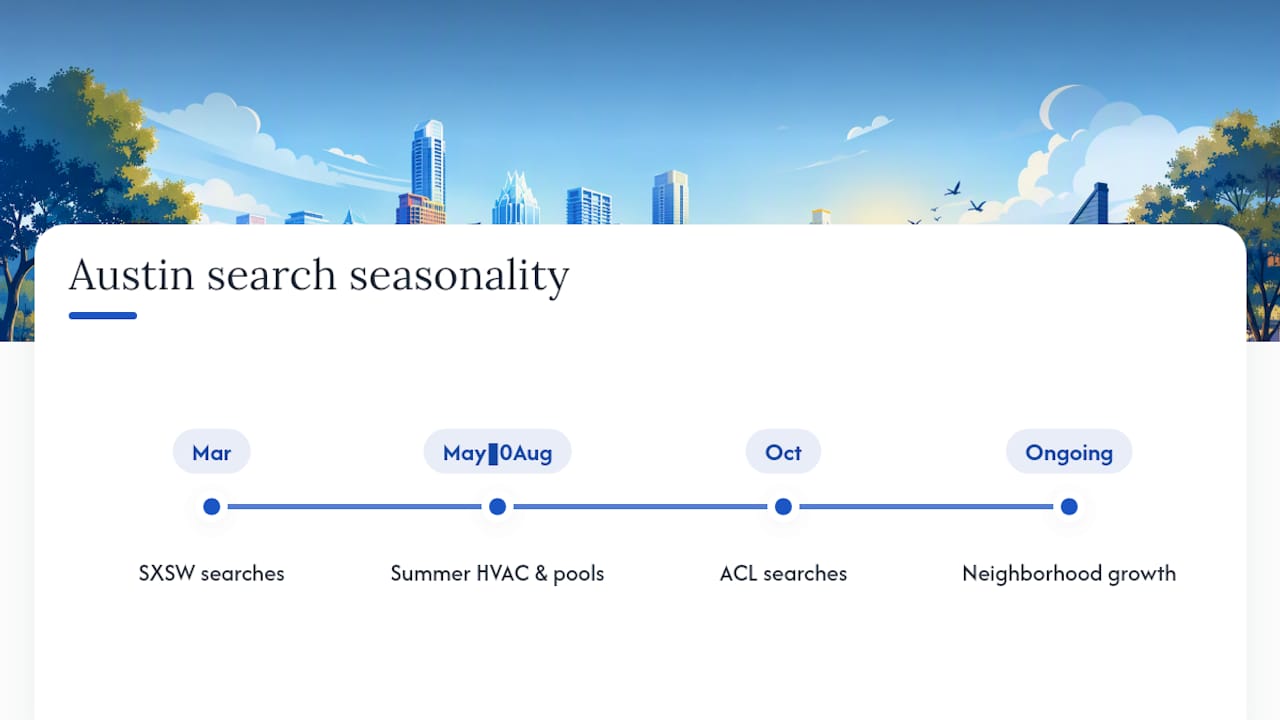
Summer heat drives seasonal demand for HVAC repair, pool services, and pest control that spikes hard from May through August, while the relatively mild winter keeps outdoor service demand steadier than in colder markets. If your business serves any of these categories, seasonal landing pages and GBP Posts timed a few weeks ahead of the seasonal spike consistently outperform content published reactively once demand has already peaked.
Austin's continued population growth, tracked through Census Bureau data, also means the competitive landscape shifts year over year as new neighborhoods develop and existing ones densify. A neighborhood that barely registered search volume two years ago, on the edges of Cedar Park or Round Rock, can become genuinely competitive as new housing developments bring in thousands of new residents.
Review your neighborhood keyword map at least twice a year rather than treating it as a set once and forget it exercise. Austin changes fast enough that a keyword strategy built in 2024 may already be missing real opportunity by 2026.
Why This Guide Skips the Generic SEO Advice
Most local SEO content treats every city the same, and that's exactly the mistake that costs Austin businesses visibility. A generic "optimize your GBP" checklist misses that South Congress customers search differently than customers in Cedar Park, and it ignores how fast this market is changing as new development pushes into once-quiet suburbs.
The uncomfortable truth is that most small business owners treat local SEO as a set-it-and-forget-it task, when it actually behaves more like a garden that needs regular tending. Citations drift out of sync. Review velocity slows the moment you stop asking. Neighborhood pages go stale when the business next door updates theirs and yours sits untouched for a year.
Where this actually pays off fastest isn't fancy schema markup or clever content tricks. It's the boring, unglamorous discipline of getting your Google Business Profile exactly right and keeping your NAP data consistent everywhere it appears. Everything else, the neighborhood pages, the content strategy, the link outreach, works better once that foundation is solid, and works for nothing if it isn't.
Rapid, mobile-first website builds matter here too, because a technically clean local SEO strategy built on a slow, confusing website is fighting itself. Forge Web Studio's approach to launching sites in days rather than months exists precisely because Austin businesses can't afford months of lost lead flow while a site gets built the slow way.
— Dylan
How Forge Web Studio Helps Austin Businesses Build This Foundation
Some web design studios offer faster, mobile-first website builds that include neighborhood pages, contact paths, and lead flow features to support local SEO foundations quickly.
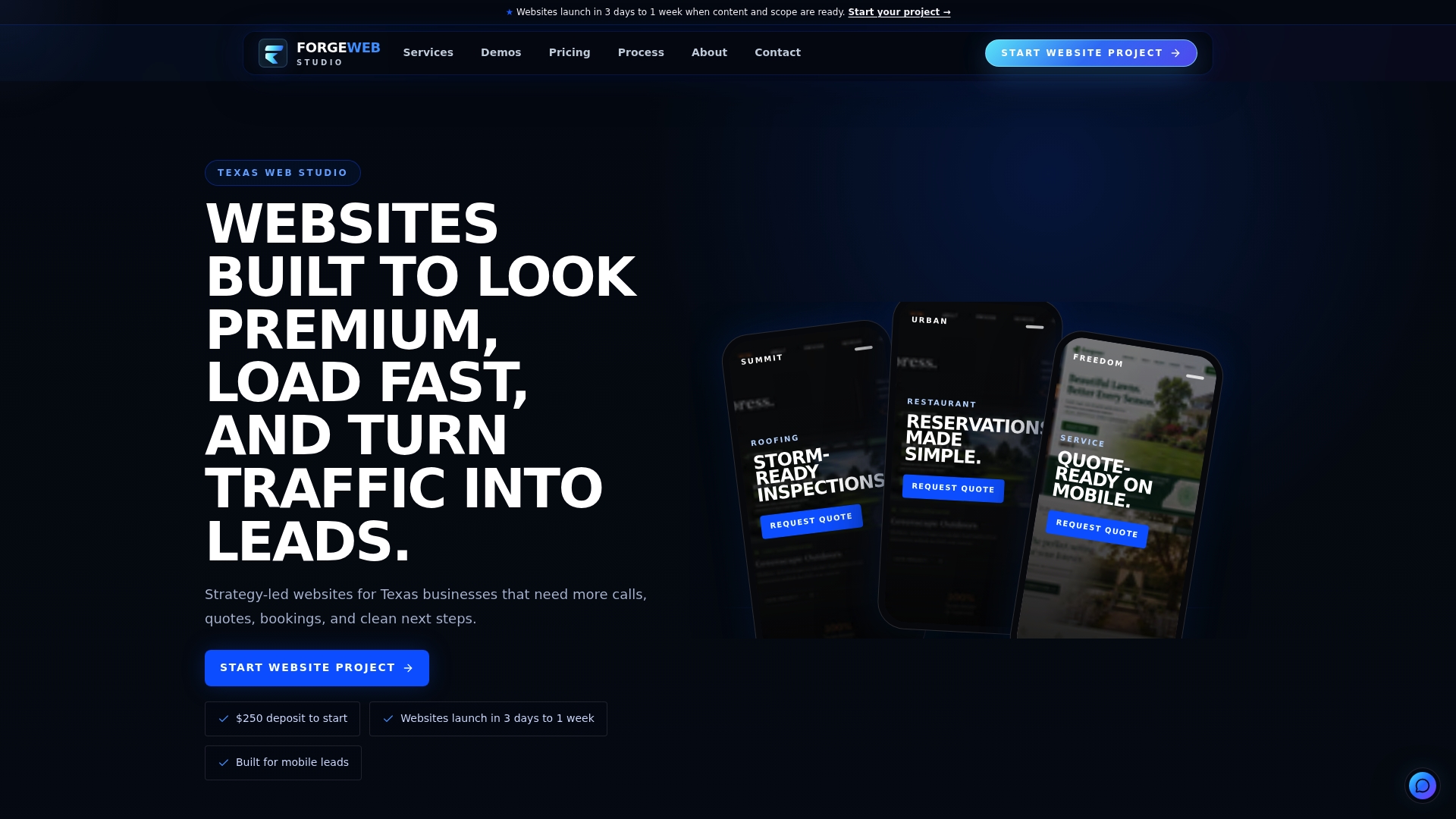
If your current site can't support neighborhood-level service pages or loads slowly on mobile, that's a website problem before it's an SEO problem. Forge Web Studio's Local SEO service builds GBP optimization, citation cleanup, and neighborhood page architecture directly into your site rather than bolting it onto a design that was never built for it. The Starter Website package begins at $500 one-off, and the Growth Website package, which fits most businesses ready for full neighborhood-level pages, starts at $1,200 one-off, with full pricing and package details on the pricing page.
You work directly with the founder throughout the build, and you keep full ownership of your site and content when it's done. If your current site is holding back the plan in this guide, request a website review and see exactly what a rapid rebuild would look like for your business.
Sources
Beyond this guide, keep Google's Business Profile help center bookmarked for field-level changes, Moz's local SEO documentation for ranking factor deep dives, Census Bureau data for neighborhood demographic research, and Google Search Console for ongoing performance monitoring. For a technical second opinion on strategy, Brainiac Media's local SEO tactics breakdown is worth a read.
FAQ
How Much Should I Pay for Local SEO in Austin?
Costs vary widely based on scope, from a few hundred dollars a month for basic citation and GBP management to several thousand for full content and link-building programs. Forge Web Studio's Local SEO service pricing details are available directly on the site.
Is SEO Dead Now That AI Search Tools Exist?
No. AI tools and assistants pull from the same structured signals, complete GBP data, schema markup, and clear service details, that traditional local SEO relies on, so the fundamentals matter more, not less.
What Is the 80/20 Rule in Local SEO?
Applied to local SEO, it means most of your visibility gains come from the key tasks that matter most: a fully optimized GBP, consistent citations, and neighborhood-relevant content, rather than chasing every minor tactic.
How Do I Get Started With Local SEO for My Austin Business?
Start with a full Google Business Profile audit and a citation consistency check, since both typically produce visible improvements within weeks. From there, build out neighborhood pages and a steady review request process.
How Long Until I See Local Ranking Results in Austin?
Expect early GBP action improvements within a few weeks of fixing profile and review issues, with fuller ranking gains across multiple Austin neighborhoods typically taking 3 to 6 months of consistent work.